
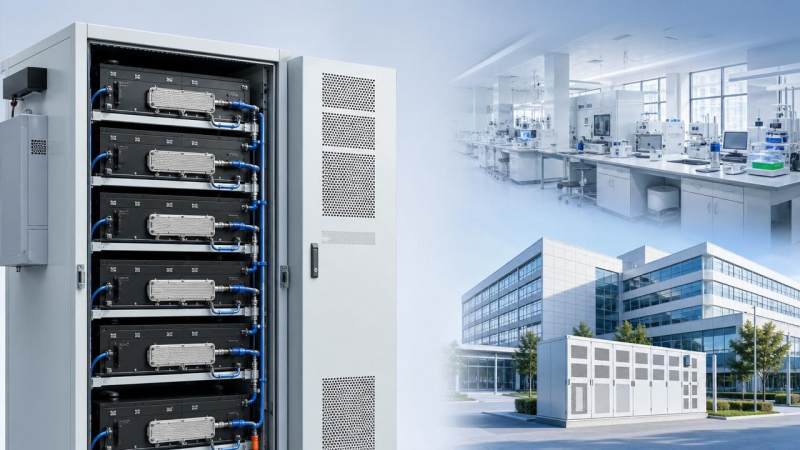
Selecting a liquid cooling ESS requires more than comparing nominal capacity or upfront cost; evaluators must examine safety, efficiency, serviceability, and operational risk.
For medical campuses, laboratories, and life science facilities, storage decisions must support reliability expectations, compliance discipline, and predictable maintenance planning.
This guide outlines practical evaluation points for assessing liquid cooling ESS solutions, with focus on battery safety, energy performance, lifecycle costs, and resilience.
What Technical Evaluators Really Need to Decide
The central question is not whether liquid cooling is advanced, but whether the system reduces risk under real operating conditions.
A strong liquid cooling ESS should maintain battery temperature uniformity, limit thermal propagation, and sustain efficiency across expected load profiles.
Technical evaluators should also verify whether maintenance tasks are clear, documented, and feasible for the facility’s engineering team.
In healthcare and research environments, an ESS is not only an energy asset; it becomes part of operational continuity planning.
That means procurement should weigh measurable reliability, emergency behavior, monitoring quality, and vendor support more heavily than marketing claims.
Why Liquid Cooling Matters for Battery Safety
Battery safety begins with temperature control because cell chemistry, degradation speed, and fault probability all depend on thermal conditions.
Compared with air cooling, liquid cooling usually provides stronger heat transfer and better temperature consistency across densely packed battery modules.
This consistency matters because uneven temperatures can accelerate aging in specific cells, creating imbalance and reducing usable system life.
For technical evaluators, the key metric is not average cabinet temperature, but maximum temperature spread between cells and modules.
Ask vendors to provide test data showing thermal performance during high-rate charge, discharge, standby, and elevated ambient conditions.
A liquid cooling ESS should also include layered protection, including battery management, coolant monitoring, insulation checks, and emergency isolation.
Safety assessment should cover thermal runaway mitigation, gas detection, ventilation strategy, fire suppression compatibility, and emergency shutdown sequences.
Facilities handling critical diagnostics or biological samples should demand documented fault responses, not general assurances about battery safety.
Thermal Architecture: What to Examine Before Approval
The cooling loop design determines whether the system remains safe and efficient as modules age or operating demands change.
Evaluators should identify whether the design uses cold plates, liquid-cooled racks, centralized chillers, or integrated cabinet-level cooling.
Each architecture affects installation complexity, redundancy options, service access, and the consequences of a coolant leak or pump failure.
Review coolant type, compatibility with seals and metals, freezing limits, corrosion control, and expected replacement or testing intervals.
Redundancy is especially important where energy storage supports medical imaging suites, cold rooms, cleanrooms, or laboratory automation systems.
A single pump, sensor, or controller should not create an unacceptable single point of failure in mission-critical applications.
Ask how the system behaves when cooling capacity declines, including derating logic, alarm thresholds, and safe shutdown procedures.
Good designs degrade gracefully; poor designs appear efficient until one component failure forces immediate interruption or unsafe operation.
Efficiency Is More Than Round-Trip Efficiency
Round-trip efficiency is important, but it can hide auxiliary consumption from pumps, cooling units, control systems, and HVAC interactions.
A liquid cooling ESS may improve cell efficiency by maintaining ideal temperatures, yet still lose value if cooling energy is excessive.
Technical evaluators should request efficiency curves across multiple loads, temperatures, operating modes, and state-of-charge ranges.
Partial-load performance is especially relevant because many facilities use storage for peak shaving, backup support, and power quality stabilization.
In those use cases, the system may spend significant time operating below rated power rather than at laboratory test conditions.
Also review standby consumption, because continuous auxiliary loads can become financially meaningful over long service periods.
For medical campuses, efficiency evaluation should include how the ESS interacts with generators, UPS systems, solar assets, and building management systems.
The best choice is usually the system with predictable net efficiency, not necessarily the highest advertised laboratory efficiency.
Battery Chemistry, Cell Quality, and Degradation Risk
Thermal management cannot compensate for poor cell quality, weak manufacturing controls, or inadequate battery management algorithms.
Most stationary ESS projects use lithium iron phosphate chemistry because of its stability, cycle life, and cost-performance balance.
However, evaluators should still examine cell supplier qualification, batch traceability, safety certifications, and aging test results.
Request degradation models based on temperature, depth of discharge, charge rate, calendar aging, and expected dispatch strategy.
A credible vendor should explain capacity retention assumptions and show how warranties handle operating conditions and usage profiles.
Liquid cooling can reduce thermal stress, but degradation also depends on control strategy and how aggressively the system is cycled.
For laboratories with unpredictable load events, conservative operating windows may deliver better lifecycle value than maximum usable capacity.
Evaluators should compare guaranteed usable energy after years of service, not only the nameplate capacity at commissioning.
Maintenance Planning: The Overlooked Selection Factor
Maintenance quality often determines whether an energy storage project remains reliable after the first few years of operation.
A liquid cooling ESS introduces components that air-cooled systems may not have, including pumps, valves, hoses, seals, and heat exchangers.
These components are manageable, but only when inspection intervals, replacement procedures, spare parts, and access requirements are clearly defined.
Evaluators should ask for a maintenance matrix covering daily monitoring, monthly inspections, annual testing, and major service milestones.
Coolant sampling, leak detection verification, filter replacement, firmware updates, and sensor calibration should all be addressed in documentation.
For facilities with strict operational windows, maintenance tasks must be scheduled without disrupting essential clinical or research activities.
Serviceability also depends on physical layout, including aisle clearance, module removal paths, lifting requirements, and lockout procedures.
A technically strong system can still be a poor choice if routine service requires excessive downtime or specialized intervention.
Monitoring, Controls, and Data Transparency
Technical evaluators should treat monitoring capability as a core safety and maintenance function, not as an optional software feature.
The system should provide visibility into cell temperature, voltage imbalance, coolant flow, pump status, insulation resistance, and alarm history.
Data granularity matters because early warning signs are often visible before a system reaches formal fault thresholds.
Facility teams should be able to export operating data for audits, performance reviews, warranty discussions, and incident investigations.
Integration with building management systems, energy management platforms, and emergency response procedures should be verified before purchase.
Cybersecurity is also relevant, especially when ESS controls connect to hospital networks or laboratory infrastructure systems.
Evaluate user permissions, remote access controls, encryption practices, software update policies, and incident response support.
Transparent data helps owners manage risk, while closed systems can make troubleshooting slower and vendor dependence stronger.
Compliance and Standards for High-Reliability Facilities
Energy storage procurement in medical and life science settings should reflect the same discipline applied to critical technical infrastructure.
Relevant standards may include battery safety, electrical installation, fire protection, environmental management, and quality system expectations.
Depending on jurisdiction, evaluators may review UL 9540, UL 9540A, IEC standards, NFPA guidance, and local electrical codes.
The goal is not to collect certificates, but to confirm that testing conditions match the proposed installation and operating scenario.
UL 9540A test results, for example, should be interpreted carefully for enclosure design, module spacing, ventilation, and propagation behavior.
Hospitals and laboratories should also align ESS planning with emergency power policies, risk assessments, and internal safety governance.
Documentation should be complete enough for facilities, safety officers, insurers, and authorities having jurisdiction to review confidently.
A vendor unwilling to provide detailed compliance evidence should be considered a higher procurement risk, regardless of price attractiveness.
Installation Environment and Site Constraints
A liquid cooling ESS must be evaluated in the context of its physical site, not only its manufacturer datasheet.
Ambient temperature, humidity, altitude, ventilation, seismic requirements, fire separation, and acoustic limits can all affect system suitability.
Indoor installations may offer environmental protection but can introduce stricter fire, access, and ventilation requirements.
Outdoor installations may simplify separation but require robust enclosure design, weather resistance, and temperature management under seasonal extremes.
Medical and research campuses often face space limitations, restricted access routes, and complex coordination with existing electrical infrastructure.
Evaluators should involve facilities, electrical engineers, safety officers, and operations teams before finalizing a system configuration.
Site acceptance testing should include communication checks, cooling performance verification, alarm simulation, emergency stop testing, and backup integration review.
A technically suitable ESS can fail project expectations if site conditions are treated as an afterthought.
Total Cost of Ownership and Lifecycle Value
Upfront cost rarely captures the real economics of a liquid cooling ESS, especially in reliability-sensitive environments.
Total cost of ownership should include installation, commissioning, auxiliary energy, preventive maintenance, replacement parts, software support, and decommissioning.
Capacity retention and warranty terms also influence financial value because degraded storage may fail to support intended operating strategies.
Evaluators should model expected use cases, such as peak demand reduction, backup bridging, renewable smoothing, or power quality support.
Each use case creates different cycling patterns, response requirements, and economic benefits that affect the appropriate system choice.
For medical campuses, avoided downtime may be more valuable than electricity savings alone, although it is harder to quantify.
Risk-adjusted value should account for vendor stability, spare parts availability, service response time, and proven deployment history.
A lower-cost system may become expensive if it increases operational uncertainty or requires frequent emergency service interventions.
Questions to Ask Vendors Before Shortlisting
Technical evaluators should use structured questions to separate mature engineering from generic sales language.
Ask vendors to provide thermal maps under rated discharge, high ambient operation, and partial-load conditions.
Request evidence of temperature uniformity, cooling redundancy, leak detection methods, and derating behavior during cooling faults.
Ask how battery management software detects imbalance, abnormal heating, insulation faults, and early signs of cell degradation.
Review maintenance requirements, including coolant service intervals, sensor calibration, pump replacement expectations, and module-level access procedures.
Confirm which alarms are local, which are remote, and how they integrate with facility emergency workflows.
Ask for reference projects with similar duty cycles, environmental conditions, and reliability requirements.
Finally, require warranty language that matches the proposed operating profile rather than an idealized laboratory scenario.
Common Selection Mistakes to Avoid
One common mistake is selecting a liquid cooling ESS mainly because it appears technologically superior.
Liquid cooling is valuable when it solves defined thermal, density, efficiency, or reliability challenges within the project’s constraints.
Another mistake is comparing systems only by nameplate capacity, ignoring usable energy, degradation, auxiliary loads, and warranty conditions.
Some teams also underweight maintenance, assuming that a sealed cabinet requires little long-term attention.
In reality, cooling loops and sensors require planned verification if they are expected to protect battery health.
A further mistake is treating compliance as a final paperwork exercise rather than an early design requirement.
This can create costly redesigns, installation delays, or disagreement with insurers and authorities during commissioning.
The best selection process combines engineering review, operational planning, compliance verification, and lifecycle cost analysis from the beginning.
How to Form a Practical Evaluation Framework
A useful framework should rank each liquid cooling ESS against safety, efficiency, maintainability, integration, compliance, and vendor support.
Safety should carry the highest weight in facilities where interruption, fire risk, or equipment damage has serious consequences.
Efficiency should be assessed as net system performance under realistic duty cycles, not as a single best-case value.
Maintainability should include both routine preventive tasks and the difficulty of responding to abnormal events.
Integration should evaluate communication protocols, control coordination, protection settings, and compatibility with existing infrastructure.
Compliance should confirm that certifications, test data, and installation assumptions align with the actual project environment.
Vendor support should include technical documentation quality, training availability, spare parts strategy, and long-term service capability.
Scoring systems are most useful when they force evidence-based comparison instead of relying on subjective impressions.
Conclusion: Choose for Controlled Risk, Not Just Capacity
A liquid cooling ESS can offer strong advantages in battery safety, temperature consistency, efficiency stability, and high-density deployment.
However, those benefits are only meaningful when the cooling architecture, controls, maintenance model, and compliance evidence are technically sound.
For technical evaluators in medical and life science environments, the best system is the one that behaves predictably over years.
That means selecting based on documented safety performance, transparent efficiency data, maintainable design, and credible vendor accountability.
When evaluated this way, liquid cooling ESS procurement becomes less about buying storage capacity and more about securing operational resilience.