
Lead Author
Institution
Published
Abstract
Choosing the right mri parts manufacturer is a critical step when uptime, compliance, and lifecycle value are under review. A reliable source does more than ship components. It supports imaging consistency, traceability, service readiness, and documentation quality across the full installed life of MRI systems.
Before any agreement is signed, technical files, quality certifications, component history, and after-sales capability should be checked in detail. A disciplined review helps reduce avoidable failures, protects regulatory confidence, and improves long-term equipment planning in hospitals, research centers, and cross-border healthcare networks.
Why a checklist matters before selecting an MRI parts manufacturer
MRI systems depend on tightly matched subsystems, not generic industrial spare parts. Gradient assemblies, RF modules, coils, power electronics, cryogenic-related items, and interface boards all affect performance differently.
A structured checklist prevents decisions based only on price or lead time. It creates a repeatable way to compare technical strength, document control, quality maturity, and service stability.
This matters in the broader medical technology sector because imaging components sit under both operational and regulatory scrutiny. Data integrity, validation history, and material conformity often matter as much as the part itself.
Core checklist: what to check before choosing an MRI parts manufacturer
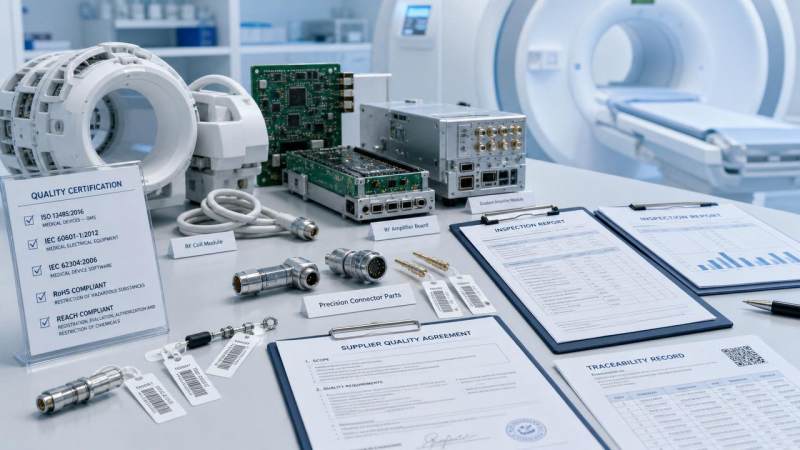
- Verify ISO 13485 alignment, documented quality procedures, change control records, and nonconformance handling before discussing price, because quality maturity usually predicts long-term supply reliability.
- Request full technical documentation, including drawings, specifications, revision history, compatibility notes, and test reports, so every MRI component can be assessed against the intended system configuration.
- Confirm component traceability down to batch, serial, or lot level, especially for electronic assemblies, precision machined parts, and materials used in safety-critical MRI subsystems.
- Check whether the mri parts manufacturer supports legacy and current platforms, because older scanners often require reverse-engineered knowledge, validated substitution logic, and disciplined documentation retention.
- Review incoming inspection, in-process control, and final acceptance testing methods to ensure parts are not only produced, but also verified under meaningful electrical and mechanical criteria.
- Ask for evidence of environmental and reliability testing, such as thermal cycling, vibration resistance, insulation verification, and connector durability where relevant to MRI operating conditions.
- Confirm compliance familiarity with FDA, CE MDR, RoHS, REACH, and region-specific documentation expectations when parts may enter regulated maintenance, refurbishment, or export workflows.
- Assess engineering responsiveness by testing how quickly technical questions are answered, whether root-cause analysis is structured, and how clearly compatibility risks are communicated.
- Examine supply-chain resilience, including approved vendor lists, second-source strategies, material availability, and obsolescence planning for semiconductors and specialized electronic components.
- Review packaging, ESD protection, labeling accuracy, and shipping controls, because high-value MRI parts can be damaged or misidentified long before they reach installation sites.
- Compare warranty terms, failure return procedures, repair turnaround, and field support options instead of focusing only on unit cost or quoted replacement lead time.
- Request references, anonymized case evidence, or performance history showing that the mri parts manufacturer has supported comparable systems under real operating conditions.
How checklist priorities change by application scenario
Hospital imaging operations
In active clinical environments, uptime and predictable service windows usually come first. The best mri parts manufacturer is one that can supply documented parts fast without creating uncertainty during installation or calibration.
For this scenario, prioritize compatibility evidence, warranty clarity, dispatch speed, and field failure analysis. A low-cost component has little value if it causes repeat service calls or imaging inconsistency.
Independent service and refurbishment programs
Refurbishment projects often involve mixed-generation systems and incomplete historical records. Here, the mri parts manufacturer should demonstrate revision tracking, substitution logic, and the ability to identify undocumented differences between part versions.
Functional testing matters more in this context because reused platforms may expose hidden tolerances. Look for manufacturers that provide clear acceptance criteria and traceable repair documentation.
Academic and research imaging environments
Research sites often need flexibility, but flexibility should not replace control. Any mri parts manufacturer serving this environment should still provide documented electrical performance, material data, and revision discipline.
This is especially important when custom setups or unusual duty cycles are involved. Small undocumented deviations can distort results, delay experiments, or complicate later validation.
Commonly overlooked risks when evaluating an MRI parts manufacturer
Missing change history
A part may match the label but not the latest approved revision. Without formal change records, fit and function problems can appear only after installation.
Weak traceability below the assembly level
Assemblies built from poorly tracked subcomponents create investigation gaps. This becomes serious when electronic failure analysis or recall support is needed.
Unclear test boundaries
Some suppliers state that a part is tested, but not how. If pass criteria, instruments, and environmental conditions are undefined, test claims offer limited assurance.
Overreliance on brokered inventory
A seller may appear capable while depending heavily on external brokers. That increases counterfeit risk, documentation gaps, and unstable availability for MRI replacement parts.
After-sales support limited to sales contacts
Technical issues require engineering depth, not only account updates. If post-sale communication lacks escalation paths, downtime can extend unnecessarily.
A practical way to evaluate and compare suppliers
Use a weighted review sheet rather than general impressions. This makes supplier comparison more objective and supports future audit readiness.
- Score documentation quality, revision control, and test evidence on separate lines rather than combining them into one broad technical category.
- Assign higher weight to traceability, compatibility validation, and response quality when the part affects safety, image stability, or system downtime.
- Request one sample document pack before purchase, including certificate copies, inspection records, and a representative failure handling workflow.
- Run a pilot order for noncritical items first, then evaluate packaging accuracy, communication speed, documentation completeness, and return handling performance.
- Document every exception, because repeated minor gaps often reveal more about a supplier than a polished presentation or attractive quotation.
Final takeaway and next action
Selecting an mri parts manufacturer should be treated as a technical and compliance decision, not simply a sourcing exercise. The right partner proves quality through records, process discipline, traceability, and support capability.
Start with a formal checklist, ask for evidence early, and compare suppliers against the same criteria. That approach improves equipment reliability, protects regulatory confidence, and creates stronger long-term value across the medical technology supply chain.
For organizations reviewing MRI supply options through a data-driven lens, independent technical benchmarks and standards-based documentation review can strengthen every sourcing decision before risk reaches the field.
Recommended News
Metadata & Tools
Related Research
- Global Wheelchair Market Growth 2026: Demand Drivers, Regional Shifts, and Buyer ImplicationsGlobal wheelchair market growth 2026 reveals key demand drivers, regional sourcing shifts, and compliance trends. See what buyers, healthcare providers, and suppliers should watch next.
- How a Trade Network for Industrial Manufacturers Helps Compare Suppliers and Reduce Sourcing RiskTrade network for industrial manufacturers helps medical and life sciences buyers compare suppliers faster, verify compliance, reduce sourcing risk, and make smarter procurement decisions.
- Maternity Support Belts Explained: Types, Fit Tips, and When to Use Themmaternitysupportbelts explained clearly: compare types, learn proper fit tips, discover when to use them, and choose the right support belt for a more comfortable pregnancy.
- How to Choose Frozen Food Packaging Solutions for Shelf Life, Leakage Control, and LogisticsFrozen food packaging solutions guide: learn how to improve shelf life, control leakage, and optimize logistics with smarter material, seal, and format choices.
- Autoclaved Aerated Concrete Blocks: Key Sizes, Density Grades, and Best Use CasesAutoclaved aerated concrete blocks explained: compare key sizes, density grades, and best use cases to choose lighter, efficient wall systems for faster, smarter projects.