
Lead Author
Institution
Published
Abstract
Where Waterjet Cutting Beats Laser Cutting in Precision Manufacturing
For technical evaluators comparing fabrication methods, the question is not whether laser cutting is fast or precise—it often is—but where waterjet cutting delivers a measurable advantage.
In medical technology, laboratory equipment, and high-spec industrial components, material integrity, thermal impact, edge quality, and regulatory consistency can matter as much as throughput.
This article examines the conditions in which waterjet cutting outperforms laser cutting, especially for heat-sensitive materials, thick sections, composites, and applications where properties must remain stable.
The Manufacturing Trend Is Moving Toward Low-Damage Cutting
Across advanced manufacturing, cutting quality is no longer judged only by speed, tolerance, or immediate part cost.
The broader trend is toward fabrication methods that preserve chemistry, microstructure, surface condition, and downstream validation confidence.
This shift makes waterjet cutting more relevant in sectors where one damaged edge can affect fatigue life, cleanliness, or assembly reliability.
Laser cutting remains highly competitive for thin metals, automated sheet processing, and high-volume profiles.
However, waterjet cutting gains importance when the material response to heat creates engineering, regulatory, or performance risk.
In medical devices, diagnostics systems, aerospace components, electronics fixtures, and research hardware, the cutting method can influence qualification evidence.
Why Waterjet Cutting Wins When Heat Becomes a Liability
The most important advantage of waterjet cutting is its cold-cutting nature.
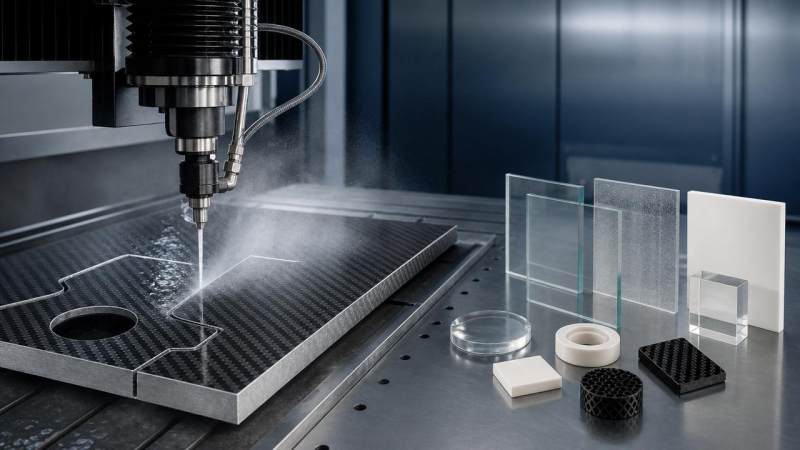
Abrasive waterjet cutting removes material through high-pressure water mixed with abrasive particles, not concentrated thermal energy.
That difference matters when a heat-affected zone could alter hardness, corrosion behavior, coating adhesion, or biocompatibility.
Laser cutting can leave recast layers, oxide scale, microcracks, discoloration, or thermal distortion, depending on material and settings.
Waterjet cutting avoids many of these thermal defects because it does not melt the workpiece.
Key drivers behind the shift
- More mixed-material assemblies require cutting without thermal mismatch damage.
- Medical and laboratory systems use polymers, ceramics, glass, and specialty metals together.
- Qualification standards increasingly value traceable process control and stable material properties.
- Miniaturized components need accurate edges without burr-related functional risk.
- Repair, prototyping, and low-volume production often require flexibility over maximum speed.
These drivers explain why waterjet cutting is often selected for sensitive, expensive, or difficult-to-replace materials.
Materials Where Waterjet Cutting Has a Clear Advantage
Material type is usually the first decision point in comparing waterjet cutting and laser cutting.
If the substrate burns, melts unevenly, reflects light, delaminates, or changes properties under heat, waterjet cutting becomes more attractive.
For mixed inventories, waterjet cutting also reduces the need for separate cutting platforms across dissimilar materials.
Thick Sections Change the Cost and Quality Equation
Laser cutting excels in thinner sheet metal, especially when rapid nesting and automated throughput dominate the decision.
As thickness increases, the comparison changes.
Waterjet cutting can process thick metals, stone, ceramics, rubber, and engineered plastics with consistent material compatibility.
The cut may be slower, but it can avoid secondary machining caused by thermal damage or heavy dross.
In high-value parts, eliminating a post-cut stress-relief step can outweigh a longer cutting cycle.
Waterjet cutting also supports thick prototypes where tooling investment is unjustified.
When thickness favors waterjet cutting
- The material is too thick for stable laser penetration.
- Edge quality must remain acceptable through the full depth.
- The part cannot tolerate heat distortion.
- The batch includes several materials and thicknesses.
- Secondary finishing would erase any laser speed advantage.
Edge Integrity Matters More in Regulated and High-Reliability Parts
In ordinary fabrication, a slightly heat-tinted edge may be acceptable.
In regulated or high-reliability applications, that edge can become a validation issue.
Waterjet cutting helps when a design requires predictable surface condition without melted material or thermal hardening.
This is relevant for surgical tools, diagnostic equipment frames, laboratory fixtures, implant trial components, and fluidic device structures.
It is also useful for non-medical parts exposed to fatigue, vibration, sterilization cycles, corrosive cleaning, or precise sealing requirements.
Waterjet cutting does not automatically eliminate finishing needs.
However, it often produces an edge condition that is easier to inspect, document, and qualify.
Composites and Laminates Reveal the Limits of Heat-Based Cutting
Composite materials are increasingly used to reduce weight, improve stiffness, and combine functional layers.
They are also challenging because fibers, resins, adhesives, and coatings respond differently to heat.
Laser cutting can vaporize resin, overheat adhesive layers, or leave charred edges requiring cleaning.
Waterjet cutting applies mechanical erosion instead, which can preserve layered structures when parameters are controlled.
For carbon fiber, fiberglass, laminated plastics, and bonded panels, waterjet cutting can reduce thermal degradation risk.
The trend toward hybrid components strengthens the case for flexible cold cutting.
Medical and Life Science Applications Need Process Evidence
In medical and life science manufacturing, the best cutting method is often the one that simplifies evidence generation.
Waterjet cutting can support documentation where material integrity, cleanability, and dimensional stability must be demonstrated.
It can be especially relevant for ISO 13485-controlled environments, prototype verification, and pre-production design iterations.
For example, laboratory equipment panels may combine stainless steel, polymers, gaskets, and transparent shields.
Waterjet cutting can handle these materials without frequent process changes linked to optical absorption or thermal behavior.
In rehabilitation technology, custom brackets and composite supports may benefit from reduced thermal stress.
In imaging and diagnostics hardware, edge cleanliness can affect shielding, assembly fit, and long-term reliability.
Where Laser Cutting Still Holds the Advantage
A balanced decision should recognize where laser cutting remains stronger.
For thin sheet metal, fine internal features, and highly automated production lines, laser cutting may deliver superior speed and lower cost.
Laser cutting also provides narrow kerf widths and excellent repeatability on compatible materials.
If heat effects are acceptable and part volume is high, laser systems can be highly efficient.
The stronger conclusion is not that waterjet cutting replaces laser cutting everywhere.
The better conclusion is that waterjet cutting beats laser cutting when thermal neutrality, material range, and edge integrity dominate.
Decision Factors That Should Guide Method Selection
The choice between waterjet cutting and laser cutting should begin with risk, not machinery preference.
A simple evaluation matrix can prevent hidden costs from appearing after the first production run.
Operational Impacts Across the Production Chain
Selecting waterjet cutting can affect design, procurement, validation, finishing, and quality control workflows.
Design teams may gain freedom to specify materials that would be troublesome under heat-based cutting.
Quality teams may benefit from fewer thermal artifacts during incoming inspection and dimensional verification.
Production planning may need to account for slower cutting speeds, abrasive consumption, water handling, and machine maintenance.
The operational benefit appears when reduced rework, simpler validation, and broader material compatibility offset those factors.
- Prototype cycles become easier when many materials share one cutting process.
- Low-volume production can avoid tooling delays.
- Finishing requirements may become more predictable.
- Material substitution decisions become less constrained by thermal cutting limits.
What to Watch Before Choosing Waterjet Cutting
Waterjet cutting has limitations that should be evaluated early.
Taper, surface striation, abrasive embedment, moisture exposure, and fixture stability can affect final part quality.
These risks are manageable, but they require defined parameters and inspection criteria.
For precision medical or laboratory components, sample coupons should be assessed before scaling production.
Core points to confirm
- Required tolerance and acceptable taper by feature type.
- Surface roughness targets after cutting and finishing.
- Abrasive compatibility with cleaning and contamination controls.
- Material response to water exposure during processing.
- Inspection plan for edge quality and dimensional repeatability.
Practical Response Strategy for Future Cutting Decisions
The strongest approach is to classify parts by heat sensitivity, thickness, material diversity, and validation burden.
Parts with low heat sensitivity and high volume may remain ideal for laser cutting.
Parts with high material risk, thick profiles, or regulatory scrutiny should be evaluated for waterjet cutting first.
Conclusion: Where Waterjet Cutting Beats Laser Cutting
Waterjet cutting beats laser cutting when heat creates more risk than speed can justify.
It is strongest for heat-sensitive materials, thick sections, composites, reflective metals, brittle substrates, and qualification-sensitive components.
Its value is not only the cut itself, but the preservation of properties after the cut.
For medical technology, laboratory systems, life science tools, and other high-spec industries, that preservation can be decisive.
A practical next step is to map parts by material risk, thickness, edge requirements, and documentation needs.
Then test waterjet cutting against laser cutting using real inspection data, not assumptions about speed alone.
That evidence-based comparison will show where waterjet cutting is the smarter, safer, and more reliable manufacturing choice.
Recommended News
Metadata & Tools
Related Research
- Portable Physiotherapy Equipment Wholesale: How to Compare Product Range, Certifications, and MOQPortable physiotherapy equipment wholesale guide: compare product range, certifications, and MOQ to reduce sourcing risk, improve compliance, and choose scalable suppliers with confidence.
- ICU Monitor ECG Benchmarks Explained: Which Parameters Matter for Device Comparison?ICU monitor ECG benchmarks explained: compare signal accuracy, noise rejection, alarm latency, and compliance factors to choose reliable ICU devices with confidence.
- Laboratory Equipment Specification Guide: How to Read Capacity, Accuracy, and Utility NeedsLaboratory equipment specification guide to decode capacity, accuracy, and utility needs. Learn how to compare specs wisely, avoid costly mistakes, and choose lab systems that fit real workflows.
- How to Evaluate a Lab Automation System for GMP: Compliance, Workflow, and ValidationLab automation system GMP evaluation starts with compliance, workflow fit, and validation readiness. Learn what to check before buying to reduce risk and choose with confidence.
- Banquet Chairs Buying Guide: Frame Materials, Stackability, and Venue Usebanquetchairs buying guide covering steel vs. aluminum frames, stackability, venue fit, and lifecycle cost—compare smarter and choose chairs that cut labor, last longer, and look professional.