
Lead Author
Institution
Published
Abstract
As the global orthopedic device market outlook continues to evolve, clinical efficacy is increasingly tied to long-term patient compliance and comfort. For procurement directors and med-tech engineers evaluating rehabilitation hardware, orthopedic brace material breathability remains a critical performance metric. Traditional choices like neoprene offer robust structural support and thermal retention, yet advanced breathable knits are disrupting the sector with superior moisture management and biocompatibility. Backed by rigorous benchmarking against international medical standards, this technical analysis explores the thermodynamic and biomechanical differences between neoprene and next-generation knitted textiles, helping decision-makers optimize patient outcomes.
The Clinical and Economic Impact of Material Breathability
In the realm of rehabilitation and home care tech, an orthopedic brace is only as effective as the patient's willingness to wear it. For hospital procurement directors and clinical project managers, evaluating the breathability of brace materials extends far beyond a simple comfort metric—it is a direct determinant of clinical efficacy and procurement ROI. Poor thermodynamic regulation leads to moisture accumulation, increasing the risk of contact dermatitis, skin maceration, and bacterial proliferation. When patients experience these adverse effects, compliance rates plummet, leading to prolonged recovery times, potential re-injury, and downstream costs for healthcare systems.
From an engineering and quality control perspective, materials must be evaluated on their moisture vapor transmission rate (MVTR) and thermal resistance. Bridging the gap between clinical innovation and regulatory compliance requires data-driven material selection that balances structural integrity with optimal microclimate management at the skin interface.
Neoprene: Evaluating the Legacy Polymer in Orthopedic Support
Polychloroprene, commonly known as neoprene, has been the foundational material in orthopedic bracing for decades. As a closed-cell synthetic rubber, neoprene excels in specific biomechanical applications. Its primary advantage lies in its high tensile strength, uniform compression, and exceptional thermal retention. For acute injury management—such as sprains or tendonitis where localized heat therapy promotes vasodilation and accelerates tissue healing—neoprene remains a highly functional choice.
However, the very properties that make neoprene effective for heat retention create significant challenges for long-term wear. The material is inherently non-breathable. While manufacturers often perforate neoprene to improve ventilation, the core material still traps sweat and heat. For technical assessors and safety management personnel, this presents a biocompatibility concern, particularly under ISO 13485 standards. Prolonged use of neoprene can lead to skin irritation, and the material itself may degrade under frequent washing protocols required in clinical settings. Therefore, neoprene is best positioned for short-term, acute clinical applications rather than chronic, continuous use.
Advanced Knits: Engineering Superior Moisture Management
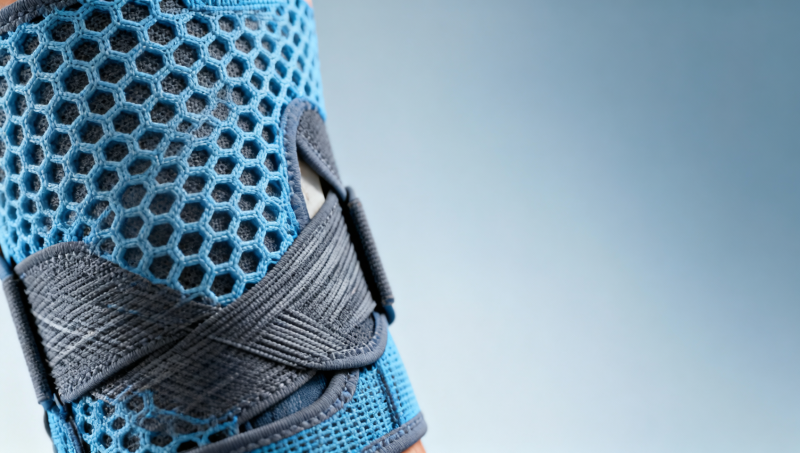
The transition from traditional synthetic rubbers to advanced 3D-knitted textiles represents a paradigm shift in medical hardware engineering. Advanced knits utilize sophisticated computer-aided manufacturing to weave synthetic fibers (such as polyamide, elastane, and polyester) into multidirectional stretch fabrics. This technology allows med-tech engineers to design braces with targeted compression zones, providing rigid support exactly where the joint needs it while maintaining flexibility in surrounding tissues.
The defining characteristic of advanced knits is their superior thermodynamics. Through capillary action, these technical textiles actively wick moisture away from the skin, dispersing it across the outer layer of the fabric where it rapidly evaporates. This highly breathable architecture maintains a dry, temperate microclimate, drastically reducing the risk of dermal complications. For enterprise decision-makers and procurement teams, while the initial manufacturing and acquisition costs of 3D-knitted braces may be higher, the investment is offset by significantly higher patient compliance rates, superior durability, and enhanced alignment with strict CE MDR and FDA biocompatibility mandates.
Technical Benchmarking: Neoprene vs. Advanced Knits
To assist technical assessors, laboratory heads, and distributors in their evaluation processes, we must benchmark these materials across key performance indicators relevant to modern medical standards.
Strategic Procurement: Aligning Hardware with Clinical Applications
For B2B buyers, distributors, and healthcare administrators, the choice between neoprene and advanced knits should not be viewed as a binary "good versus bad," but rather as an alignment of material science with specific clinical pathways.
- When to Procure Neoprene: Focus on procurement for post-trauma acute care, water sports rehabilitation, and scenarios requiring aggressive heat therapy. It is a cost-effective solution for short-duration treatments where thermal retention is a prescribed clinical requirement.
- When to Procure Advanced Knits: Prioritize for chronic conditions (e.g., osteoarthritis), prophylactic sports bracing, and post-operative recovery requiring extended daily wear. The breathability and variable compression make knits the superior choice for high-end retail distribution, orthopedic clinics, and long-term rehabilitation programs where patient adherence is the primary success metric.
Conclusion: Advancing Evidence-Based Med-Tech Procurement
As the med-tech industry continues to prioritize patient-centric care, the breathability of orthopedic brace materials has evolved from a secondary feature to a primary clinical requirement. While neoprene remains a structurally robust and cost-effective option for targeted, short-term heat therapy, advanced 3D-knitted textiles represent the future of biomechanical support. By offering superior moisture management, targeted compression, and enhanced biocompatibility, breathable knits directly address the patient compliance issues that have historically hindered rehabilitation outcomes.
For hospital procurement directors, med-tech engineers, and clinical distributors, understanding these thermodynamic and biomechanical differences is crucial. By benchmarking material performance against clinical needs and international regulatory standards, healthcare networks can optimize their supply chains, reduce total cost of care, and ensure that their rehabilitation hardware meets the rigorous demands of modern precision medicine.
Recommended News
Metadata & Tools
Related Research
- Immunoassay Cross-Reactivity Metrics: Calculating Percentages and Assessing BiasMaster immunoassay cross-reactivity metrics: learn to calculate percentages, assess assay bias, and evaluate clinical impact with practical examples for better-informed decisions.
- Choosing a Lab Tools Supplier: Quality Checks, Lead Times, and Warranty TermsChoose a lab tools supplier with confidence. Discover how to verify quality, confirm lead times, and compare warranty terms to avoid costly delays and protect your lab’s budget.
- Choosing Interactive Pet Toys: Matching Size, Play Style, and Safety NeedsExplore nteractivepettoys matched to your pet’s size, play style, and safety needs. Compare puzzles, treat dispensers, and moving toys to choose smarter and make playtime more rewarding.
- NGS Sequencing Cost Benchmark Report: Comparing Total Costs per SampleNGS sequencing cost benchmark report: compare total costs per accepted sample, uncover hidden expenses, and evaluate suppliers with confidence to make smarter procurement decisions.
- Diagnostic Imaging Market Outlook: Growth Opportunities in CT, MRI, and UltrasoundExplore the diagnostic imaging market outlook for CT, MRI, and ultrasound. Discover growth opportunities, technology trends, and procurement insights to guide smarter healthcare investments.