
Lead Author
Institution
Published

Abstract
As rna therapeutics manufacturing trends accelerate, CDMO selection is shifting from simple capacity checks to deeper evaluations of quality systems, scalability, and regulatory readiness. For information researchers and technical users alike, this transition connects closely with precision oncology clinical trials, single-cell multi-omics insights, and global bioreactor market trends—making it essential to understand how RNA production strategy now influences outsourcing decisions, risk control, and long-term innovation value.
For procurement teams, laboratory managers, and technical operators, the new reality is clear: manufacturing is no longer a back-end function that starts after discovery. In RNA therapeutics, process design, raw material control, analytical release, fill-finish compatibility, and cold-chain planning can shape program timelines as early as preclinical development. A CDMO that appears sufficient on paper may still fall short when a candidate moves from gram-scale screening to multi-batch clinical supply.
This matters across the broader medical and life sciences landscape served by G-MLS, where decision-making depends on verifiable technical detail rather than marketing language. Whether the end user is evaluating mRNA, siRNA, saRNA, circRNA, or antisense manufacturing pathways, the same question applies: which outsourcing model can support quality, scale, compliance, and long-term platform flexibility without introducing preventable operational risk?
Why RNA manufacturing trends are changing CDMO evaluation criteria
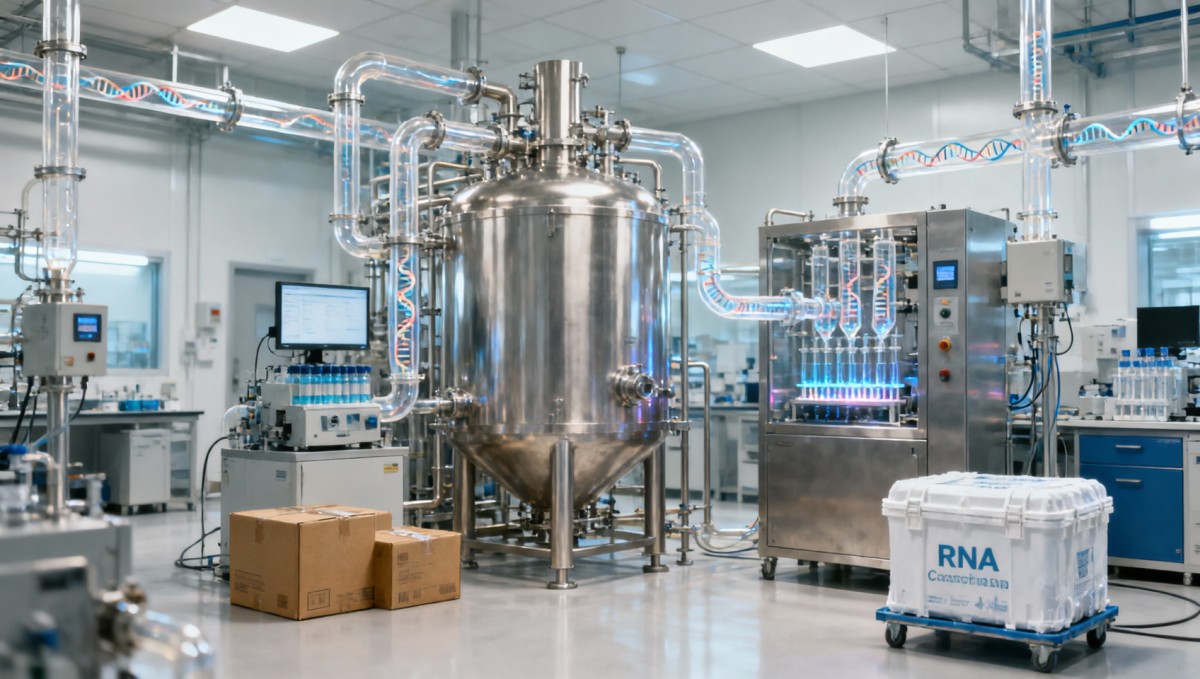
The first major shift is the diversification of RNA modalities. Five years ago, many outsourcing discussions centered on conventional mRNA process capability. Today, buyers may need support for modified nucleotides, lipid-based formulation, plasmid template preparation, in vitro transcription, enzymatic capping, tangential flow filtration, and sterile fill-finish within one integrated pathway. That broader scope raises the bar for CDMO selection.
A second trend is timeline compression. Early-phase sponsors often expect process transfer or development kick-off within 2–6 weeks, not 3–4 months. Clinical supply windows are also narrowing, especially in precision oncology studies where patient stratification depends on biomarker-defined cohorts. In these settings, manufacturing delays of even 14–21 days can affect site activation, enrollment scheduling, and release planning.
The third trend is greater analytical scrutiny. RNA integrity, residual DNA, dsRNA impurities, endotoxin levels, particle characterization, and encapsulation efficiency must now be reviewed as linked quality attributes rather than isolated data points. For technical users, this means the CDMO’s analytical maturity is as important as reactor volume or cleanroom size.
Finally, the market has moved from capacity-first thinking to risk-adjusted capability assessment. A site with 50 L, 200 L, or even 1,000 L bioreactor access may still underperform if batch records are inconsistent, deviation closure takes longer than 30 days, or technology transfer relies heavily on manual interventions. Buyers increasingly want visible control over each stage, from raw material qualification to release documentation.
What information researchers and operators now look for
Information researchers typically focus on comparability, regulatory readiness, and supply-chain resilience. Operators focus on process repeatability, equipment fit, sampling practicality, and batch execution support. In RNA programs, these priorities are closely linked because a weak operational design often becomes a regulatory or delivery problem later.
- Can the CDMO support at least 3 development stages: process development, GMP clinical supply, and scale-up readiness?
- Are critical quality attributes measured by validated or phase-appropriate analytical methods?
- Is there a defined material strategy for nucleotides, enzymes, plasmids, lipids, single-use consumables, and sterile components?
- How many manual handoffs occur between synthesis, purification, formulation, and fill-finish?
These questions reflect a broader procurement trend across life science operations: buyers want manufacturing platforms that reduce hidden complexity, not just increase nominal output.
Core technical capabilities that now matter more than nominal capacity
In RNA therapeutics manufacturing trends, nominal batch size is becoming a secondary indicator. A 10 L or 30 L process with strong control of yield, impurity clearance, and formulation reproducibility may be more valuable in Phase I than a larger but unstable platform. This is especially true when dose requirements vary by indication, route of administration, and lipid nanoparticle composition.
For many buyers, the real issue is whether a CDMO can maintain process consistency across scale transitions. Moving from milligram feasibility batches to gram-scale engineering runs and then to GMP lots often exposes weak transfer packages. Common failure points include poor plasmid linearization consistency, incomplete in vitro transcription optimization, and insufficient filtration performance during downstream polishing.
Another technical priority is platform adaptability. A supplier may perform well for one mRNA construct but struggle when sequence length, GC content, or modified base selection changes. Facilities that can quickly adjust enzyme ratios, reaction times, purification conditions, and formulation parameters within a controlled framework are better positioned for multi-program portfolios.
Cold-chain compatibility also matters more than before. Some products require storage at 2–8°C for short-term handling, while others depend on -20°C or -70°C conditions for longer stability windows. If packaging, fill volume, vial configuration, or transport qualification are not aligned early, manufacturing success can still lead to distribution failure.
Key capability areas to assess during CDMO screening
The table below summarizes capability areas that should be reviewed before technical transfer or supplier shortlisting. It is designed for cross-functional teams that include sourcing, quality, process development, and end-user operations.
The strongest CDMO candidates usually show balanced capability across all four areas, not just one. A technically advanced synthesis suite without mature analytical release control can create the same downstream risk as limited scale-up infrastructure.
Typical process checkpoints
- Feasibility assessment within 5–10 business days, including sequence-specific manufacturing considerations.
- Development plan covering 3–6 critical process parameters and target analytical outputs.
- Engineering run review before GMP commitment, with deviation and recovery pathways defined.
- Release package alignment for clinical shipment, storage, and site handling.
For users on the operational side, these checkpoints improve visibility and reduce the chance that manufacturing decisions are made too late in the program lifecycle.
Quality systems, regulatory readiness, and documentation depth
As RNA pipelines mature, quality systems have become a central differentiator in CDMO selection. It is no longer enough to confirm that a site operates under GMP principles. Buyers increasingly review how deviations are handled, how quickly investigations are closed, how electronic and paper records are reconciled, and whether change control supports rapid development without weakening traceability.
For information researchers, one practical marker is documentation depth. A capable partner should provide clear process descriptions, equipment fit rationale, material specifications, sampling plans, and release logic. If key information is fragmented across different teams or delivered only after repeated requests, the risk of misalignment during transfer increases sharply.
Regulatory readiness also depends on the ability to justify phase-appropriate controls. Early clinical programs may not require the same validation depth as commercial supply, but they still need controlled methods, documented acceptance criteria, and a rationale for critical parameter ranges. Gaps in these areas often surface during sponsor audits or dossier preparation, when correction is more expensive and slower.
From a user perspective, documentation quality affects daily execution. Operators need batch instructions that are practical, not just compliant. If steps are ambiguous, if hold times are poorly defined, or if intervention points are unclear, even well-equipped sites can experience variability.
Documentation elements that should be requested early
Before final selection, procurement and technical teams should compare CDMOs on documentation maturity. The table below highlights useful review points that often reveal whether a partner is prepared for fast-moving RNA programs.
When these records are available and coherent, audit preparation becomes more efficient and operational teams gain confidence in execution. In practice, documentation strength often predicts how well a CDMO will perform under schedule pressure.
Four quality questions worth asking
- What is the typical timeframe for deviation closure: under 30 days, 30–60 days, or longer?
- How are critical process changes reviewed during active clinical supply campaigns?
- Which records are available before contract signature, and which only after project initiation?
- Can the site support sponsor audit requests within 1–2 weeks when timelines are compressed?
These questions help move the conversation from general compliance claims to practical execution capability.
Supply chain, bioreactor context, and scale-up planning in a volatile market
RNA therapeutics manufacturing trends are also being shaped by the wider bioprocess equipment market. Even when RNA synthesis itself is enzyme-driven rather than cell-culture dominated, the broader availability of single-use systems, mixing technologies, filtration hardware, and sterile processing capacity affects scheduling and cost. Global bioreactor market trends matter because many CDMOs share infrastructure, utilities, and procurement channels across biologics, vaccines, and nucleic acid programs.
This creates a practical risk: apparent capacity may be constrained by upstream competition for cleanroom slots, qualified operators, consumables, and release testing bandwidth. A supplier that advertises multiple suites may still face bottlenecks if disposable assemblies have lead times of 8–16 weeks or if specialized lipids are sourced through a narrow vendor base.
Scale-up planning should therefore be viewed as a supply system exercise, not only a process exercise. For example, a program targeting Phase I may require only small GMP lots, but if successful expansion cohorts begin within 6–9 months, the sponsor needs visibility into larger batch pathways, additional formulation capacity, and packaging throughput. Without that planning, a clinical success can quickly become a manufacturing bottleneck.
For technical operators, another overlooked factor is change sensitivity. Switching filters, tubing sets, mixing assemblies, or cryostorage formats may seem operationally minor, yet these changes can influence recovery, particle characteristics, or handling efficiency. Mature CDMOs document such dependencies early.
Procurement checkpoints for supply resilience
The following list can be used during vendor qualification to assess whether a CDMO’s supply chain is resilient enough for RNA development and clinical manufacturing.
- Review sourcing strategy for 5 key categories: enzymes, nucleotides, plasmid materials, lipids, and single-use assemblies.
- Confirm backup planning for components with lead times longer than 12 weeks.
- Ask how production slots are prioritized across RNA, biologics, and other customer programs.
- Verify whether cold-chain packaging validation covers 24-hour, 48-hour, and 72-hour transport scenarios.
- Check if scale-up pathways have been mapped before first GMP execution.
These checkpoints are highly relevant for procurement directors and lab heads who need a realistic view of continuity, not just quoted price and initial launch dates.
Common sourcing mistakes
One common mistake is assuming that process transfer is complete once batch parameters are documented. In reality, transfer is incomplete until material specifications, logistics timing, storage conditions, and release interfaces are also aligned. Another mistake is prioritizing the lowest-cost option without modeling rework risk, repeat analytical runs, or expedited shipment costs.
A more resilient approach is to evaluate total program impact over at least 2 development horizons: immediate clinical supply and the next likely scale step. That perspective helps organizations avoid selecting a partner that can start fast but cannot grow with the program.
How to choose the right CDMO for RNA programs: a practical framework
A strong CDMO decision framework should combine technical fit, quality confidence, supply resilience, and communication discipline. This is especially important in RNA programs linked to precision oncology clinical trials and single-cell multi-omics workflows, where manufacturing timelines often intersect with complex biomarker data and highly specific patient enrollment windows.
For information researchers, a useful method is to compare suppliers across 4 weighted dimensions: process capability, quality system maturity, program management responsiveness, and scale-up feasibility. For operators, the same matrix can be translated into daily execution factors such as clarity of batch records, sampling workflow, intervention control, and release predictability.
This framework is not just for large sponsors. Academic spinouts, translational research groups, and regional biotech teams can use it to reduce vendor-selection bias and focus on measurable risk. In many cases, a mid-sized CDMO with tighter documentation and better technical communication may outperform a larger network with fragmented ownership across sites.
The goal is to identify a partner that can support the program through changing requirements, not merely complete the next batch. In RNA development, flexibility under control is more valuable than raw scale without process discipline.
Decision matrix for CDMO shortlisting
The matrix below can support supplier comparison during request-for-information or technical due diligence stages.
Using a matrix like this improves internal alignment between procurement, quality, and laboratory teams. It also reduces the chance that decisions are made on one attractive feature while hidden operational gaps remain unresolved.
FAQ for buyers and technical users
How long does RNA CDMO onboarding usually take?
For a prepared sponsor, initial technical evaluation may take 2–4 weeks. A full transfer package review, gap assessment, and project initiation often adds another 2–6 weeks, depending on analytical complexity and material readiness.
What are the most common red flags during supplier review?
Frequent red flags include unclear ownership between development and GMP teams, lack of backup supply plans, vague analytical acceptance criteria, and response delays that exceed 7–10 business days during due diligence.
Is larger manufacturing scale always better for RNA therapeutics?
Not necessarily. For early clinical programs, controlled small-to-mid scale execution can be preferable if it offers stronger reproducibility, faster change management, and more reliable release documentation.
Which teams should be involved in CDMO selection?
At minimum, include procurement, process development, quality assurance, analytical representatives, and the operational users who will manage execution. A 4–6 person review team is common for efficient but balanced decision-making.
RNA therapeutics manufacturing trends are redefining what a capable CDMO looks like. The strongest partners are not simply those with available suites or large equipment footprints, but those that combine phase-appropriate process control, robust documentation, practical regulatory readiness, and supply continuity across changing program needs.
For G-MLS readers working in research, procurement, and technical operations, the most effective outsourcing decisions come from disciplined comparison of quality systems, analytical depth, transfer clarity, and scale-up logic. This approach supports safer clinical execution, more stable timelines, and better long-term platform value.
If you are evaluating RNA manufacturing partners, refining procurement criteria, or mapping technology and regulatory risks across the medical and life sciences sector, now is the right time to build a more evidence-based selection framework. Contact G-MLS to explore tailored intelligence support, compare technical pathways, and obtain a more informed view of RNA outsourcing strategies.
Recommended News
Metadata & Tools
Related Research
- Immunoassay Cross-Reactivity Metrics: Calculating Percentages and Assessing BiasMaster immunoassay cross-reactivity metrics: learn to calculate percentages, assess assay bias, and evaluate clinical impact with practical examples for better-informed decisions.
- Choosing a Lab Tools Supplier: Quality Checks, Lead Times, and Warranty TermsChoose a lab tools supplier with confidence. Discover how to verify quality, confirm lead times, and compare warranty terms to avoid costly delays and protect your lab’s budget.
- Choosing Interactive Pet Toys: Matching Size, Play Style, and Safety NeedsExplore nteractivepettoys matched to your pet’s size, play style, and safety needs. Compare puzzles, treat dispensers, and moving toys to choose smarter and make playtime more rewarding.
- NGS Sequencing Cost Benchmark Report: Comparing Total Costs per SampleNGS sequencing cost benchmark report: compare total costs per accepted sample, uncover hidden expenses, and evaluate suppliers with confidence to make smarter procurement decisions.
- Diagnostic Imaging Market Outlook: Growth Opportunities in CT, MRI, and UltrasoundExplore the diagnostic imaging market outlook for CT, MRI, and ultrasound. Discover growth opportunities, technology trends, and procurement insights to guide smarter healthcare investments.