
Lead Author
Institution
Published
Abstract
At first glance, linear guide rail wholesale looks like a smart way to cut unit cost and simplify sourcing.
However, low visible pricing can conceal serious quality risks.
In medical devices, laboratory automation, imaging systems, and broader industrial equipment, hidden rail defects can reduce accuracy, increase vibration, and trigger premature failure.
When components move diagnostic heads, robotic arms, or precision sample stages, even minor inconsistency matters.
That is why evaluating linear guide rail wholesale should extend beyond price lists and delivery promises.
It requires material verification, tolerance review, traceability checks, and alignment with standards affecting safety and compliance.
What does linear guide rail wholesale really include beyond bulk pricing?
Many buyers treat linear guide rail wholesale as a simple volume purchase.
In reality, it often includes complex variables hidden behind one quotation.
These variables include steel grade, heat treatment depth, grinding method, surface roughness, preload class, lubrication path, and packaging control.
Two offers may look identical in catalog format.
Yet they can differ sharply in fatigue life, corrosion resistance, noise behavior, and repeatability.
This matters especially in the G-MLS context, where technical transparency supports safer engineering decisions.
For integrated medical and life science systems, guide rails influence motion stability in analyzers, imaging modules, rehabilitation devices, and controlled laboratory platforms.
A bulk order can also include mixed production batches.
If batch controls are weak, one shipment may contain parts with uneven hardness or dimensional drift.
That makes linear guide rail wholesale a technical sourcing decision, not just a procurement exercise.
Key wholesale variables to verify
- Material certificate origin and lot traceability
- Rail straightness and parallelism tolerances
- Block preload consistency across batches
- Surface treatment and corrosion protection
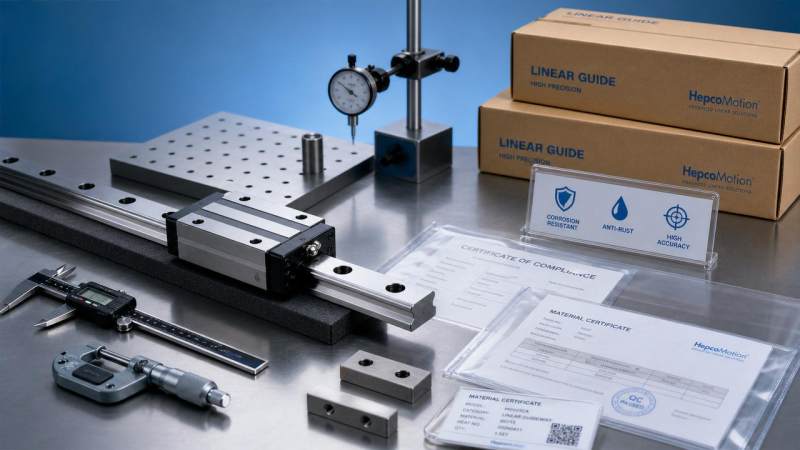
- Cleanliness, rust prevention, and sealed packaging
- Inspection method, sample size, and acceptance criteria
Why can linear guide rail wholesale hide quality risks more easily than single-piece sourcing?
Bulk transactions can reduce inspection visibility.
When order quantities rise, practical inspection often shifts from piece-by-piece validation to sampling.
That creates room for latent defects to pass unnoticed.
Some defects are cosmetic and easy to spot.
Others only emerge under load, speed, thermal cycling, or long operating hours.
Examples include uneven raceway hardness, micro-pitting, poor lubrication channel machining, or ball circulation instability.
Linear guide rail wholesale may also involve outsourced sub-processes.
If grinding, heat treatment, or plating are performed by different contractors, process variation increases.
Without transparent control documents, the final rail may not match the declared specification.
This is especially risky for systems requiring validated motion accuracy.
In diagnostic platforms, tiny linear errors can influence calibration, dispensing precision, or image registration quality.
Common hidden risk patterns
- Certificates reused for non-matching lots
- Declared tolerances based on ideal samples only
- Mixed grades shipped under one model number
- Insufficient preservative causing corrosion during transit
- Inconsistent preload causing variable noise and drag
Which applications are most exposed to hidden wholesale guide rail defects?
Not every application faces the same risk level.
Exposure increases when motion precision, hygiene, repeatability, or uptime directly affect outcome quality.
Medical and life science platforms are particularly sensitive.
Automated analyzers rely on stable movement for liquid handling and sample transfer.
Imaging equipment depends on controlled travel to preserve alignment and resolution.
Surgical and hospital infrastructure may require smooth, low-noise motion under repeated cycles.
Rehabilitation devices need reliable load handling and consistent user safety.
Life science research tools often demand low contamination risk and exact positioning.
Outside healthcare, semiconductor, optics, packaging, and robotics systems face similar concerns.
In these settings, low-grade linear guide rail wholesale can create downtime that outweighs any initial savings.
High-sensitivity scenarios
- Sample transport stages in IVD systems
- Detector movement in imaging assemblies
- Precision adjustment modules in laboratory tools
- Quiet linear motion in patient-facing equipment
- Continuous-duty industrial automation lines
How can quality be judged before approving a linear guide rail wholesale order?
A reliable decision should combine document review, physical testing, and process verification.
Catalog claims alone are not enough.
Start with technical drawings and dimensional tolerances.
Confirm whether stated values reflect international measurement practice.
Then review hardness range, material designation, lubrication design, and environmental suitability.
For critical systems, request sample rails from the same production route intended for mass delivery.
Evaluate them under realistic load, speed, and contamination conditions.
Traceability is another major control point.
Every linear guide rail wholesale shipment should connect rail markings, inspection records, and material lots.
Where regulated products are involved, poor traceability can complicate audits and corrective actions.
It is also useful to compare supplier quality systems with frameworks such as ISO 13485 when the end use touches medical technology.
Even if the rail itself is not a medical device, its performance can affect validated equipment behavior.
Pre-approval checklist
- Verify drawing revision and exact model definition
- Check lot-based material and hardness records
- Request dimensional and running accuracy reports
- Inspect sample performance under use conditions
- Confirm packaging, storage, and anti-corrosion method
- Define nonconformance handling before shipment
Is the cheapest linear guide rail wholesale offer ever the most economical choice?
Usually not.
A lower unit price can hide higher lifecycle cost.
This includes installation delays, alignment rework, replacement frequency, warranty disputes, and field service expense.
In regulated sectors, the cost can rise further.
Unexpected rail variation may trigger revalidation, document updates, or deeper root-cause investigations after performance drift.
Cheap linear guide rail wholesale also increases planning uncertainty.
One bad lot can interrupt several assemblies at once.
That concentration risk becomes severe when there is no approved backup source.
A better approach is total cost analysis.
Compare not only purchase price, but also acceptance yield, maintenance interval, field reliability, and documentation quality.
What practical safeguards reduce risk in linear guide rail wholesale programs?
Risk reduction begins before the first order.
Set a technical specification that defines more than dimensions.
Include hardness, roughness, accuracy class, lubrication requirements, cleanliness level, and packaging expectations.
Next, qualify the source using pilot lots.
Do not assume that an acceptable sample guarantees stable mass production.
For linear guide rail wholesale, ongoing surveillance is essential.
Use incoming inspection plans tied to application criticality.
Track field failures, rail noise trends, and wear patterns.
If performance shifts, isolate the lot quickly and compare process history.
Finally, build documentation discipline.
This supports internal quality systems and aligns with the evidence-based engineering mindset promoted by G-MLS.
Recommended safeguards
- Define application-specific acceptance standards
- Approve pilot lots before volume release
- Require batch traceability on every shipment
- Audit process changes affecting rail performance
- Monitor lifecycle data after installation
Linear guide rail wholesale can deliver value, but only when technical quality remains visible from material source to installed performance.
The greatest risk is not the obvious defect.
It is the hidden inconsistency that escapes early review and appears later as drift, downtime, or compliance trouble.
Use a structured review process, test representative lots, and document every critical parameter.
That approach makes linear guide rail wholesale safer, more predictable, and more suitable for precision-driven medical and industrial systems.
The next practical step is simple.
Compare current wholesale specifications against real application risk, then close the gaps before the next bulk order is approved.
Recommended News
Metadata & Tools
Related Research
- Immunoassay Cross-Reactivity Metrics: Calculating Percentages and Assessing BiasMaster immunoassay cross-reactivity metrics: learn to calculate percentages, assess assay bias, and evaluate clinical impact with practical examples for better-informed decisions.
- Choosing a Lab Tools Supplier: Quality Checks, Lead Times, and Warranty TermsChoose a lab tools supplier with confidence. Discover how to verify quality, confirm lead times, and compare warranty terms to avoid costly delays and protect your lab’s budget.
- Choosing Interactive Pet Toys: Matching Size, Play Style, and Safety NeedsExplore nteractivepettoys matched to your pet’s size, play style, and safety needs. Compare puzzles, treat dispensers, and moving toys to choose smarter and make playtime more rewarding.
- NGS Sequencing Cost Benchmark Report: Comparing Total Costs per SampleNGS sequencing cost benchmark report: compare total costs per accepted sample, uncover hidden expenses, and evaluate suppliers with confidence to make smarter procurement decisions.
- Diagnostic Imaging Market Outlook: Growth Opportunities in CT, MRI, and UltrasoundExplore the diagnostic imaging market outlook for CT, MRI, and ultrasound. Discover growth opportunities, technology trends, and procurement insights to guide smarter healthcare investments.