
Lead Author
Institution
Published
Abstract
High-throughput platforms differ most in how they protect workflow under pressure
For a laboratory processing large daily volumes of immunoassays, analyzer selection is rarely decided by the highest published tests-per-hour figure. Two platforms with similar nominal throughput can behave very differently when the workload includes urgent samples, repeat testing, calibration, maintenance, reagent changes, and uneven demand across the day.
The practical question is: which system can deliver the required turnaround time and result quality without creating avoidable manual work or bottlenecks elsewhere in the laboratory? High-throughput immunoassay analyzer platforms differ in their assay architecture, sample and reagent logistics, automation depth, menu strategy, integration model, and service burden. Those differences determine whether a platform suits a centralized core laboratory, a hospital laboratory with a heavy urgent-care load, or a network preparing to consolidate testing.
A platform should therefore be assessed as a workflow system, not simply as an instrument. The most appropriate choice is often the one that maintains predictable output during busy periods, rather than the one that appears fastest in a controlled specification sheet comparison.
Throughput figures need to be read in context
Manufacturers may state throughput in tests per hour, but that number can reflect different operating conditions. It may represent a single assay type, a fully loaded instrument, uninterrupted processing, or a configuration that does not reflect the laboratory's real mix of routine and urgent work. A laboratory running thyroid, fertility, infectious disease, cardiac, oncology, and endocrine assays will create a different demand pattern from one focused primarily on a narrower routine menu.
The useful distinction is between peak analytical speed and sustained operational throughput. Sustained throughput accounts for the interruptions that occur in normal laboratory operation: sample loading, dilution, reflex testing, reruns, reagent replacement, quality control, calibration, waste handling, and scheduled maintenance. It also includes the consequences of a short queue forming at one step in the process. A high-speed analytical module does little to improve turnaround time if samples wait to be accessioned, centrifuged, uncapped, transported, or released through the laboratory information system.
For this reason, procurement teams should ask vendors to model their own workload rather than accept a headline throughput claim. The model should include hourly sample arrivals, the proportion of STAT requests, expected assay distribution, repeat rates, and the desired turnaround time by test category. A daily total alone can conceal the operational problem. Many laboratories have sufficient capacity over 24 hours but still struggle during a two- or three-hour morning peak.
Platform architecture also matters. Some systems scale through a single larger analyzer, while others use multiple modules or linked analytical units. A larger single system can simplify the footprint and operating model, but an interruption in a shared component may affect a larger portion of output. Modular configurations can improve resilience and allow capacity to be added in stages, although they may introduce more complex routing, maintenance planning, and validation work.
High throughput does not automatically mean high flexibility. A platform optimized for large batches of routine testing may be highly efficient under stable demand, while a system designed for continuous random access can perform better when test requests arrive unpredictably. Laboratories should identify which of those patterns describes their work before comparing configurations.
Sample handling is often the hidden differentiator
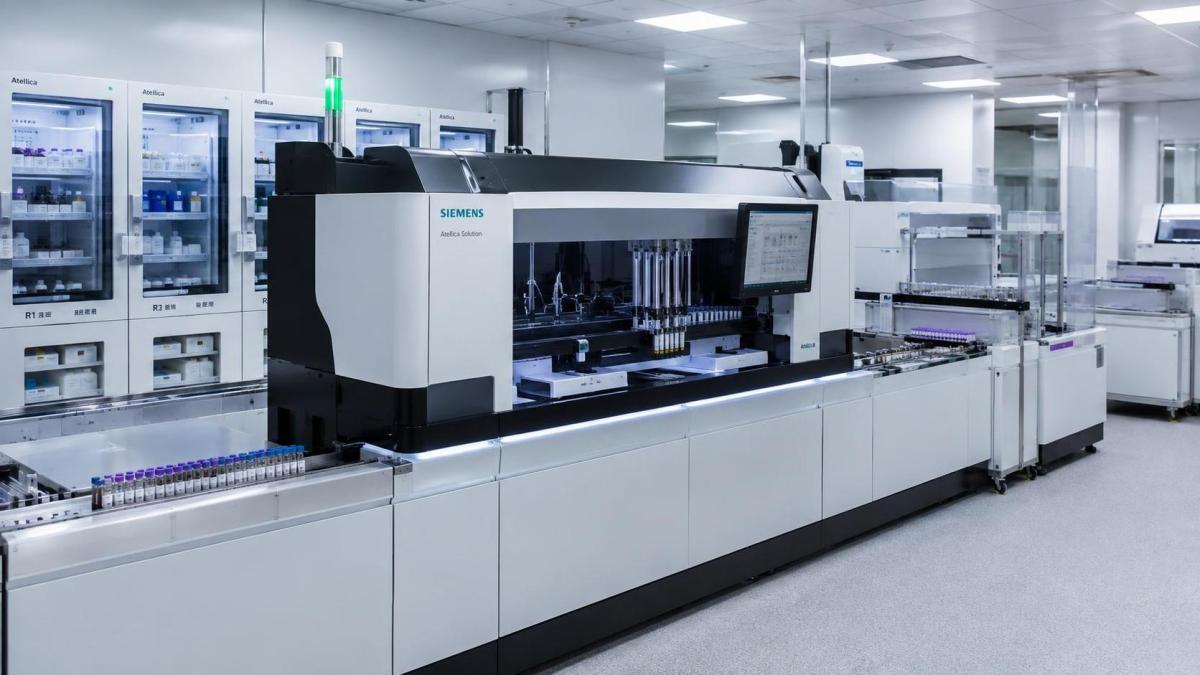
In high-volume settings, pre-analytical and sample-management design can have more effect on daily performance than a modest difference in analytical speed. The platform must reliably identify, prioritize, transport, aliquot where necessary, and retain specimens while minimizing manual touches. Each manual intervention creates a possible delay and a potential source of identification or handling error.
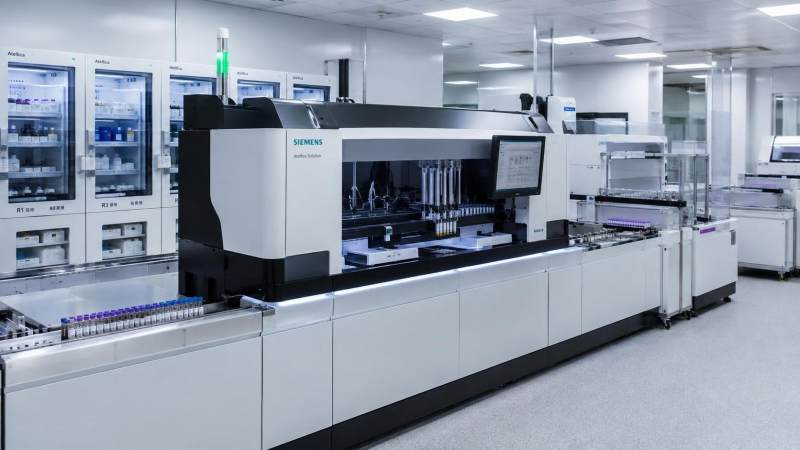
Some immunoassay analyzers are designed as standalone systems with onboard loading, while others are intended to operate on a laboratory automation track. The first arrangement may be appropriate where volume is high but the laboratory layout, budget, or test mix does not justify a broader automation line. The second can be advantageous when many specimens move between chemistry, immunoassay, hematology, coagulation, and storage systems. Yet track connection alone does not guarantee a better workflow. Routing rules, tube compatibility, priority handling, and exception management must be examined in detail.
STAT handling deserves particular attention. A platform may offer priority sample access, but the laboratory should determine how this works when the analyzer is near capacity. Questions worth resolving include whether urgent samples can enter without interrupting routine flow, whether they receive priority across linked modules, and whether an urgent test requires a specific sample container, manual placement, or separate worklist action. A stated STAT feature is of limited value if staff must search for samples or manually override the queue during every surge.
Sample retention and retrieval can also affect downstream work. Reflex testing, add-on requests, confirmation testing, and clinician queries are common sources of repeat access to a specimen. Laboratories should understand how long samples remain available, whether the system supports automated retrieval from connected storage, and how it handles specimens that are insufficient, unsuitable, or already committed to another analyzer. These details are particularly relevant in hospitals where a specimen may support multiple departments and multiple testing platforms.
Assay menu breadth matters, but menu fit matters more
Assay menu comparisons can become misleading when they focus on the number of available tests. A broad menu can reduce the need for separate instruments, simplify training, and consolidate quality processes. It may also help a laboratory bring selected tests in house as demand changes. However, the most relevant question is whether the platform covers the assays that drive volume, clinical urgency, and operational complexity in that specific laboratory.
A core lab may value a menu that combines high-volume endocrine and infectious disease assays with cardiac markers and specialized tests that are currently split across several systems. Another facility may place more value on continuity for a smaller group of high-priority assays and refer low-volume specialties to an external laboratory. Buying a broad menu to avoid referrals can be reasonable, but only when projected demand supports the added validation, inventory, calibration, quality control, and staff competency obligations.
Assay availability should be assessed at the method level as well as the menu level. Laboratories may need to compare analytical measuring range, sensitivity, interference characteristics, sample type requirements, calibration frequency, turnaround time, and behavior at decision thresholds. A test with the same clinical name is not necessarily operationally interchangeable across platforms. Changes in method performance can require clinician communication, historical result review, revised reference intervals, or parallel testing during transition.
Menu strategy also intersects with resilience. If a laboratory places nearly all immunoassay volume on one platform, an unplanned outage can have broad consequences. Some sites intentionally retain a second method for selected critical assays, either through another instrument, a nearby network laboratory, or a defined referral pathway. That decision adds complexity, but it can be justified when service continuity for time-sensitive testing is more important than maximum consolidation.
Reagent design shapes labor, waste, and uptime
Reagent management is a major source of operational variation between platforms. Relevant differences include onboard storage capacity, refrigerated storage design, reagent pack format, pack stability after loading or opening, barcode control, automatic inventory monitoring, and the ease of replacing consumables without stopping routine work.
A platform with substantial onboard reagent capacity may reduce staff intervention during long runs and support overnight operation. Its value depends on how much of the laboratory's active menu can actually remain onboard. If common assays fit comfortably but frequently used specialty reagents require repeated manual loading, the promised labor benefit will be smaller than expected. Conversely, very large onboard inventory may offer little benefit to a laboratory with a stable but narrow menu and regular daytime staffing.
Reagent utilization should be considered alongside purchase price. Pack size, expiry management, residual volume, calibration use, and demand variability all affect the amount of reportable testing obtained from each reagent order. Low-volume assays are especially sensitive to this issue. A favorable per-test price can be undermined when reagent packs expire before sufficient patient samples are run, or when small residual volumes cannot support a full remaining test cycle.
Consumable logistics are equally important. Probe wash, reaction vessels, pipette tips where applicable, cuvettes, water, waste capacity, and maintenance fluids can all determine how often staff must intervene. The best way to evaluate these features is to map the daily interventions required under the laboratory's intended workload, including nights, weekends, and periods when technical support staff are limited.
Automation should reduce exceptions, not merely add hardware
High-throughput platforms vary considerably in what they automate. Automated loading and unloading, repeat handling, dilution, reflex testing, rerun rules, clot or volume detection, and quality-control processing can reduce routine handling. Their value depends on the quality of the exception workflow. A system may automate most normal samples but still demand frequent manual decision-making for failed runs, insufficient volume, unusual sample types, or results requiring additional testing.
Laboratories should ask to see how exceptions appear to operators. Clear worklists, actionable alarms, traceable sample status, and sensible recovery steps matter more than the number of automated functions listed in a brochure. A complicated interface can turn a manageable technical event into a queue of delayed samples, particularly during a shift change or when a less experienced operator is covering the bench.
The same principle applies to reflex and repeat rules. Rule-based automation can reduce delay and improve consistency, but rules need to reflect the laboratory's validated clinical and analytical policies. Decision-makers should establish whether local rules can be configured, how changes are controlled, how exceptions are documented, and whether the system supports the required audit trail. A vendor's default workflow may not match local clinical pathways or information-system practices.
Connectivity determines whether capacity becomes usable capacity
An analyzer is part of a larger information environment. Laboratory information system and middleware connectivity influence order transmission, result reporting, autoverification, sample routing, quality review, error handling, and traceability. Poorly designed integration can leave staff performing manual reconciliation even when the analytical process is highly automated.
For a new installation or replacement project, integration assessment should begin early. Teams need to understand the required message formats, test code mapping, result flags, instrument identifiers, reflex order behavior, downtime procedures, and responsibility for interface validation. These are not administrative details. A result that cannot be transmitted, interpreted by middleware, or released safely is not a completed test from the laboratory's perspective.
Data availability also affects operational management. Useful platforms support visibility into workload queues, reagent status, calibration validity, quality-control trends, maintenance events, and error history. The goal is not simply to collect more instrument data. It is to give laboratory leaders enough information to identify recurring causes of delay, plan staffing, and detect a declining performance pattern before it becomes a service disruption.
Regulatory and quality requirements should be built into the selection process
For hospital and reference laboratories, technical suitability cannot be separated from quality-system obligations. The intended use, local regulatory status, documentation package, service records, change-control process, cybersecurity posture, and traceability capabilities all need to support the laboratory's operating environment. International frameworks such as ISO 13485, FDA requirements, and CE marking under the applicable European medical-device framework may be relevant depending on the market and the laboratory's procurement rules, but they do not remove the need for local validation and governance.
Validation effort can vary substantially when replacing one immunoassay method with another. A laboratory may need to establish or verify precision, comparability, reportable range, reference intervals, quality-control performance, and clinical implications for selected assays. The burden is usually greatest for analytes where clinicians monitor trends over time or make decisions near a defined cutoff. Selection teams should consider the transition plan before contract award, including access to technical documentation, reagent lots, application support, training, and the availability of parallel testing capacity.
Service design is another quality issue. The relevant question is not whether a supplier offers support, but whether the support model aligns with the consequences of downtime. Review preventive maintenance requirements, planned service windows, remote diagnostics, parts availability, escalation procedures, and the laboratory's contingency arrangements. A system that is economical under normal operation may become costly when a failure disrupts a high-priority clinical service.
Comparing total cost requires a workflow view
Instrument acquisition cost is only one component of platform economics. A sound comparison includes reagents, consumables, quality-control materials, calibrators, service, connectivity, installation, validation, training, utilities, space, waste handling, and labor. It should also reflect referral testing that may continue after installation, as well as the cost of retaining backup capacity for critical assays.
Labor is often difficult to estimate because automation changes tasks rather than simply removing them. Less time may be spent loading samples, but more may be required for exception review, inventory management, quality oversight, interface support, or maintaining connected automation. The right comparison identifies which roles are affected, when those tasks occur, and whether the change improves staffing flexibility during peak periods.
- Model hourly demand, not only annual test volume.
- Separate routine, urgent, repeat, reflex, and low-volume specialty assays.
- Calculate reagent utilization with expected expiry and residual-volume losses.
- Include validation, interface work, training, and transition-period parallel testing.
- Define the cost and response plan for partial or full platform downtime.
These questions expose the trade-offs that headline pricing can conceal. A lower-cost instrument may fit well when volume is predictable and the menu is narrow. A more automated or modular platform may justify its higher cost where staff capacity is constrained, urgent demand is substantial, or a laboratory needs to consolidate several workflows without sacrificing continuity.
A useful selection decision begins with the failure points
When comparing high-throughput immunoassay analyzer platforms, laboratories should first identify where their present workflow fails: delayed STAT samples, manual reagent changes, insufficient overnight capacity, fragmented menus, repeated sample handling, interface exceptions, or lack of backup during downtime. The preferred platform is the one that addresses those specific constraints with the least additional operational burden.
That approach produces a more defensible decision than ranking systems by throughput alone. Analytical speed remains important, but in a high-throughput laboratory it is only one part of a larger question: how reliably can the platform turn a varied stream of specimens into validated, reportable results when the workflow is under real clinical pressure?
Recommended News
Metadata & Tools
Related Research
- How to Interpret Clinical Equipment Specifications for Safe Hospital ProcurementClinical equipment specifications explained for safer hospital procurement—compare performance, compliance, interoperability, lifecycle costs, and workflow fit.
- Outdoor Furniture Buying Guide: Materials, Weather Resistance, and Space PlanningOutdoor furniture buying guide: compare durable materials, weather resistance, cushion care, and smart space planning to create a comfortable, long-lasting outdoor retreat.
- How to Evaluate a DNA Extraction Kit Manufacturer for Consistent Yield and PurityDNA extraction kit manufacturer evaluation guide: compare yield consistency, purity, quality controls, support, and supply reliability for confident purchasing.
- Long-Read Sequencing: When Does It Outperform Short-Read NGS for Variant Analysis?Long read sequencing outperforms short-read NGS for structural variants, repeat expansions, phasing, and hard-to-map genes. Discover when its added resolution delivers value.
- What Determines Battery Cycle Life in Mobility Scooters—and How to Extend ItWheelchair battery cycle life for mobility scooters: discover charging, storage, and maintenance tips to extend range, avoid failures, and ride with confidence.