
Lead Author
Institution
Published
Abstract
In telemedicine, healthcare accessibility standards are no longer optional—they are essential to delivering safe, equitable, and compliant care at scale. For organizations operating across med-tech, hospital systems, and life sciences, these standards shape platform design, procurement decisions, regulatory readiness, and long-term digital health performance. When accessibility is built into telemedicine from the start, patient reach expands, clinical communication improves, and operational risk declines.
Why healthcare accessibility standards need a checklist approach
Telemedicine combines software, clinical workflows, devices, documentation, and patient interaction. That complexity makes healthcare accessibility standards difficult to assess through intuition alone.
A checklist creates consistency across product evaluation, vendor review, implementation planning, and compliance oversight. It also helps connect accessibility to patient safety, service quality, and evidence-based governance.
For technical repositories and healthcare intelligence platforms such as G-MLS, checklist-based evaluation supports transparent comparison across systems, standards, and digital care infrastructure.
Core checklist for telemedicine accessibility
Use the following checklist to evaluate whether healthcare accessibility standards are embedded in telemedicine strategy and execution.
- Audit interface usability across screen readers, keyboard navigation, captioning, color contrast, and text scaling before deployment in clinical or home-care environments.
- Verify alignment with recognized frameworks such as WCAG, ADA expectations, Section 508, and regional digital health accessibility requirements.
- Test patient journeys end to end, including registration, consent, symptom intake, video visits, follow-up messaging, and payment workflows.
- Assess compatibility with assistive technologies used by patients with visual, hearing, motor, cognitive, or speech-related limitations.
- Review multilingual support, plain-language instructions, and interpreter integration to reduce communication barriers during remote consultations.
- Check device interoperability across desktops, tablets, smartphones, connected diagnostics, and low-bandwidth network conditions.
- Require accessible documentation, including informed consent forms, discharge summaries, educational materials, and technical support content.
- Map accessibility controls to cybersecurity and privacy safeguards so secure authentication does not unintentionally block vulnerable users.
- Measure accessibility performance continuously through user testing, complaint tracking, abandonment data, and post-visit quality indicators.
- Assign accountability within governance, procurement, engineering, clinical operations, and compliance teams to maintain accessibility over time.
Why healthcare accessibility standards matter beyond compliance
Many organizations first encounter healthcare accessibility standards through legal or regulatory pressure. That is understandable, but too narrow.
In telemedicine, poor accessibility can distort clinical information. A patient who cannot hear instructions clearly or navigate intake forms may provide incomplete data.
That affects diagnosis quality, treatment adherence, and continuity of care. Accessibility therefore supports clinical accuracy, not just user convenience.
Healthcare accessibility standards also protect investment value. Digital platforms that exclude segments of the population create avoidable rework, low adoption, and reputational damage.
For cross-border healthcare technology ecosystems, standardized accessibility strengthens benchmarking, procurement defensibility, and alignment with international quality expectations.
Application scenarios that demand stronger accessibility controls
Remote specialist consultations
Specialist teleconsultations often involve complex terminology, imaging review, and decision-sensitive discussions. Accessibility features must support comprehension under clinical pressure.
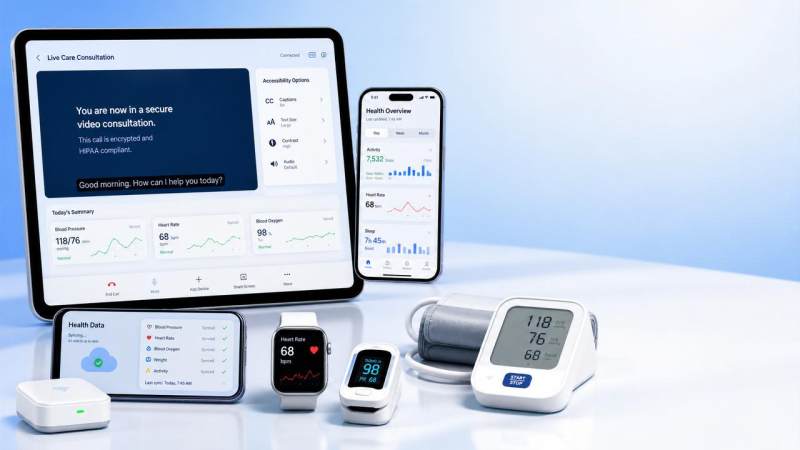
Captioning, adjustable display settings, interpreter access, and structured summaries improve patient understanding and reduce errors during high-stakes virtual visits.
Chronic disease management
Long-term telemedicine programs depend on repeated engagement. If portals are difficult to use, adherence falls and remote monitoring loses clinical value.
Healthcare accessibility standards support sustained participation for older adults, rehabilitation patients, and users managing multiple devices at home.
Laboratory result communication
Digital delivery of IVD results and follow-up guidance must be accessible, especially when abnormal findings require immediate action.
Clear formatting, screen-reader compatibility, and plain-language explanation reduce delay, confusion, and escalation risk across distributed care networks.
Home care and rehabilitation technology
Rehabilitation and home-care telehealth frequently serve people with mobility, sensory, or cognitive challenges. Accessibility cannot be layered on afterward.
Accessible interfaces, low-friction onboarding, and support for adaptive hardware are central to safe remote therapy and care continuity.
Commonly overlooked gaps in healthcare accessibility standards
One common gap is treating video accessibility as the whole problem. Telemedicine accessibility includes scheduling, forms, messaging, consent, and aftercare documentation.
Another gap is assuming mobile-first design equals inclusive design. Small screens can increase friction for users needing magnification, keyboard alternatives, or simplified navigation.
A third risk is ignoring low-bandwidth access. Healthcare accessibility standards should consider rural connectivity, unstable networks, and asynchronous care options.
Organizations also overlook accessible procurement language. If contracts and technical specifications omit healthcare accessibility standards, enforcement becomes inconsistent after purchase.
Finally, many teams fail to retest accessibility after updates. New authentication flows, AI triage tools, or device integrations can introduce fresh barriers.
Practical execution steps for stronger telemedicine accessibility
- Start with a baseline audit using healthcare accessibility standards relevant to your operating regions and digital health obligations.
- Prioritize high-risk workflows, especially intake, consent, urgent communication, and remote diagnostic interpretation.
- Integrate accessibility requirements into RFPs, technical validation, vendor scorecards, and update approval processes.
- Run usability testing with diverse participants, including users of assistive technologies and individuals with intermittent connectivity.
- Document remediation actions, ownership, deadlines, and evidence trails for governance and regulatory review.
- Monitor performance through operational metrics such as no-show rates, portal abandonment, failed login patterns, and complaint categories.
This execution model helps translate healthcare accessibility standards from policy language into measurable digital care performance.
Conclusion and next actions
Healthcare accessibility standards matter in telemedicine because they directly influence safety, usability, equity, compliance, and long-term infrastructure quality.
They are not a side requirement for niche users. They are a foundation for resilient digital healthcare systems.
The next step is practical: review current telemedicine workflows against a structured checklist, identify high-friction barriers, and align future technology decisions with verifiable accessibility criteria.
For organizations relying on rigorous technical intelligence, that approach supports better digital health outcomes and more trustworthy innovation across the medical and life sciences landscape.
Recommended News
Metadata & Tools
Related Research
- Portable Physiotherapy Equipment Wholesale: How to Compare Product Range, Certifications, and MOQPortable physiotherapy equipment wholesale guide: compare product range, certifications, and MOQ to reduce sourcing risk, improve compliance, and choose scalable suppliers with confidence.
- ICU Monitor ECG Benchmarks Explained: Which Parameters Matter for Device Comparison?ICU monitor ECG benchmarks explained: compare signal accuracy, noise rejection, alarm latency, and compliance factors to choose reliable ICU devices with confidence.
- Laboratory Equipment Specification Guide: How to Read Capacity, Accuracy, and Utility NeedsLaboratory equipment specification guide to decode capacity, accuracy, and utility needs. Learn how to compare specs wisely, avoid costly mistakes, and choose lab systems that fit real workflows.
- How to Evaluate a Lab Automation System for GMP: Compliance, Workflow, and ValidationLab automation system GMP evaluation starts with compliance, workflow fit, and validation readiness. Learn what to check before buying to reduce risk and choose with confidence.
- Banquet Chairs Buying Guide: Frame Materials, Stackability, and Venue Usebanquetchairs buying guide covering steel vs. aluminum frames, stackability, venue fit, and lifecycle cost—compare smarter and choose chairs that cut labor, last longer, and look professional.