
Lead Author
Institution
Published
Abstract
Which ISO Standards Apply to Medical Imaging Equipment Calibration?
What ISO standards apply to medical imaging equipment calibration procedures? The answer requires distinguishing measurement competence from medical-device quality management. ISO/IEC 17025 addresses competent laboratory testing and calibration, while ISO 13485 governs quality management for medical devices. Neither provides a universal calibration procedure for every CT scanner, MRI system, ultrasound unit, or nuclear medicine camera.
A defensible program combines the relevant ISO requirements with modality-specific IEC standards, manufacturer instructions, and applicable local rules. The practical question is not simply whether a service provider “has ISO.” It is whether its methods, measurement capabilities, and records support the particular equipment and clinical use.
Start by separating calibration from performance testing
Imaging departments often use “calibration” to describe several different activities. In metrology, calibration establishes the relationship between an instrument’s indications and reference values, including the associated measurement uncertainties. It does not necessarily include adjustment, repair, or a pass/fail decision.
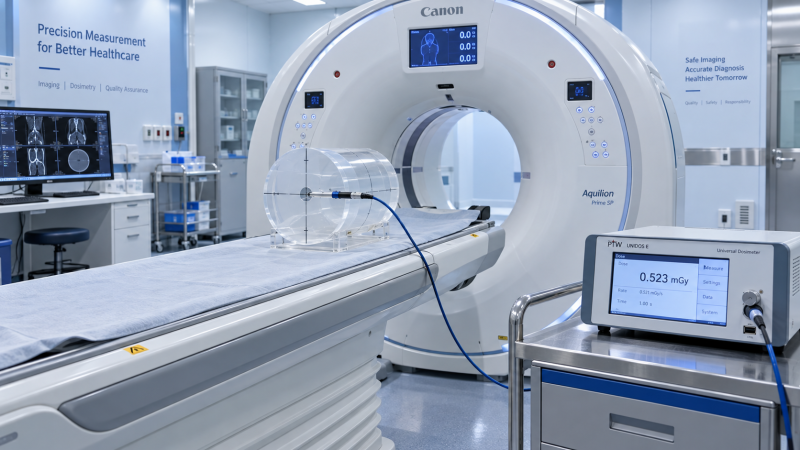
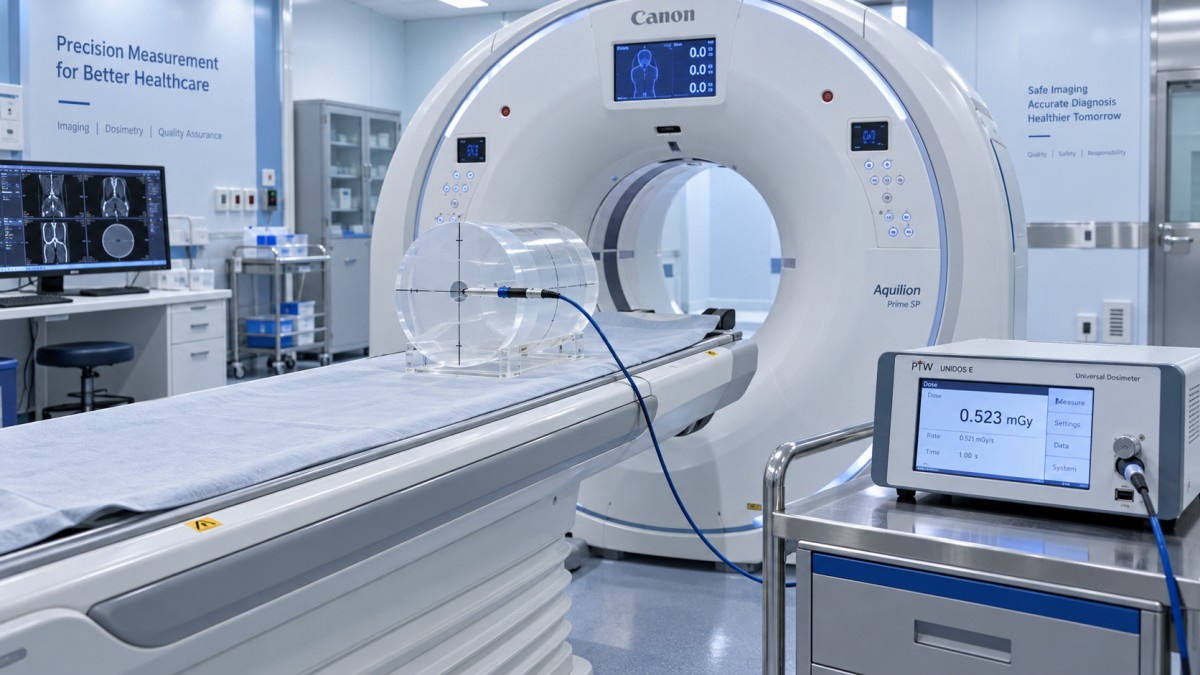
A scanner’s automated detector correction may be called calibration by its manufacturer. A physicist measuring image uniformity may be conducting a constancy test. A laboratory calibrating the dosimeter used during that test is performing another, distinct activity. These processes support one another, but their evidence is not interchangeable.
Acceptance testing establishes whether an installed system meets agreed requirements. Routine quality control checks for deterioration against defined limits or baselines. Preventive maintenance addresses equipment condition. Keeping these categories separate prevents a maintenance certificate from being mistaken for proof of measurement accuracy or clinical image quality.
The ISO standards—and what each actually establishes
ISO/IEC 17025: look beyond the accreditation logo
ISO/IEC 17025 is usually the most directly relevant standard when evaluating an external calibration laboratory. It addresses personnel competence, methods, equipment, metrological traceability, measurement uncertainty, and reporting.
However, a laboratory accredited for electrical measurements is not automatically accredited to calibrate diagnostic X-ray dosimeters. Review its published scope for the actual measurand, range, method, and calibration and measurement capability. Where work occurs also matters: confirm whether the relevant on-site activity falls within the accredited scope.
Traceability belongs to a measurement result, not merely to an instrument bearing a sticker. The evidence should establish a documented calibration chain to an appropriate reference, with each stage contributing to uncertainty. Where SI traceability is technically possible, that chain should support it; other appropriate references may be needed where it is not.
ISO 13485: control of measurement within the quality system
ISO 13485 is relevant to manufacturers and service organizations whose quality-management scope includes the activities concerned. Its requirements for monitoring and measuring equipment include calibration or verification at specified intervals, or before use, against suitable traceable standards where available.
The quality system must also address equipment identification, calibration status, protection from inappropriate adjustment, and records. When equipment is found unsuitable, the organization needs to assess the validity of previous measurement results and take appropriate action.
This is why an ISO 13485 certificate and an ISO/IEC 17025 accreditation answer different questions. One concerns the organization’s medical-device quality system; the other concerns competence for specified laboratory activities. Neither should be presented as a substitute for the other.
Supporting standards are not universal obligations
ISO 10012 can help structure an organization-wide measurement management system. ISO 14971 provides a risk-management framework for medical devices, which can inform how manufacturers address calibration-related hazards. Their applicability depends on the organization’s role, contractual obligations, and regulatory context.
ISO 15189:2022, meanwhile, addresses medical laboratory quality and competence. It may be relevant within a wider diagnostic organization, but it is not the default standard for a radiology department merely because imaging supports diagnosis.
Why imaging-specific IEC standards still matter
ISO standards generally establish management or competence requirements. The imaging modality determines which technical quantities need evaluation and which methods are appropriate. That is where IEC publications and manufacturer procedures become essential.
For CT, the IEC 61223 series includes provisions addressing acceptance and constancy testing, with IEC 61223-3-5 covering CT imaging performance. Depending on the applicable protocol, assessment may include CT-number accuracy, noise, uniformity, spatial resolution, and radiation output. These are related performance checks, not a single calibration operation.
For MRI, IEC 62464-1 addresses determination of essential image-quality parameters. IEC 60601-2-33 addresses particular safety and essential-performance requirements for MR equipment. Neither means every routine image-quality measurement requires an accredited calibration certificate; the method must identify which reference instruments and artifacts need metrological control.
For ultrasound, IEC 61391-1 addresses calibration of spatial measurement systems and measurement of system point-spread-function response. The IEC 61675 series addresses characteristics and test conditions for radionuclide imaging devices. These references illustrate why a generic “ISO-compliant imaging calibration” claim is too vague to evaluate.
Check the publication’s scope, edition, amendments, and national adoption before using it in a specification. IEC 60601 safety requirements should not be treated as a complete routine quality-control schedule, and a type-test method may not be appropriate for field servicing without adaptation.
Turn the standards into a workable calibration procedure
A useful procedure begins with the measurement and its purpose—not with a certificate template. For an X-ray output measurement, for example, the reference instrument must be suitable for the relevant radiation qualities and measurement conditions. A valid certificate alone does not establish suitability outside its stated range or conditions.
The procedure should then connect five elements:
- Defined measurand: specify what is measured, its units, equipment configuration, and operating conditions.
- Controlled method: identify the manufacturer procedure, applicable technical standard, and any justified deviations.
- Suitable references: document calibration status, applicable corrections, uncertainty, and relevant phantom or artifact characteristics.
- Acceptance criteria: identify where tolerances come from and how uncertainty affects any conformity decision.
- Response to failure: define escalation, adjustment authority, retesting, and review of potentially affected previous results.
Where a laboratory reports conformity to a tolerance, the decision rule matters. A result close to a limit can lead to different conclusions depending on how uncertainty is considered. Agree on that rule before work begins rather than debating it after an unexpected failure.
There is also no universal ISO requirement that all imaging equipment be calibrated annually. Intervals should reflect applicable legal and manufacturer requirements, equipment stability, use, environmental conditions, and the consequences of error. Repair, component replacement, relocation, or software changes may trigger additional checks, depending on what changed.
What documentation should procurement and engineering request?
Ask for the proposed work scope before comparing prices. It should separate scanner adjustments, image-quality testing, radiation measurements, reference-instrument calibration, and electrical safety checks. Otherwise, two quotations carrying the same “calibration” label may cover substantially different work.
For calibration results, request equipment identification, method, measurement conditions, results, relevant uncertainty, and traceability information. If adjustments are made, pre-adjustment and post-adjustment results are particularly valuable: the final passing result alone cannot show whether earlier measurements may have been affected.
For imaging performance reports, retain acquisition settings, phantom identification, analysis methods, baseline comparisons, acceptance limits, and reviewer approval. A report stating only “passed” provides little help when a later investigation needs to reconstruct the equipment’s condition.
Finally, verify the provider’s current accreditation scope and the relevance of any quality-system certification. Local radiation protection rules, licensing conditions, and contractual requirements may impose additional obligations. FDA requirements and the EU Medical Device Regulation are regulatory frameworks, not ISO calibration standards, and should be assessed separately.
Use evidence that matches the decision
For Global Medical & Life Sciences (G-MLS), an independent technical repository and academic intelligence hub, the useful benchmark is the connection between a standards claim and verifiable evidence. Across imaging, laboratory equipment, hospital infrastructure, rehabilitation technology, and research tools, the same distinction holds: organizational certification, measurement competence, and equipment performance are different forms of assurance.
Before approving an imaging calibration program, identify the measurements that matter clinically, the applicable technical methods, and the evidence needed for each. Then check whether the provider’s scope, reference equipment, uncertainty, and reporting support those requirements. A certificate is useful only when it answers the question the equipment actually presents.
Recommended News
Metadata & Tools
Related Research
- Immunoassay Cross-Reactivity Metrics: Calculating Percentages and Assessing BiasMaster immunoassay cross-reactivity metrics: learn to calculate percentages, assess assay bias, and evaluate clinical impact with practical examples for better-informed decisions.
- Choosing a Lab Tools Supplier: Quality Checks, Lead Times, and Warranty TermsChoose a lab tools supplier with confidence. Discover how to verify quality, confirm lead times, and compare warranty terms to avoid costly delays and protect your lab’s budget.
- Choosing Interactive Pet Toys: Matching Size, Play Style, and Safety NeedsExplore nteractivepettoys matched to your pet’s size, play style, and safety needs. Compare puzzles, treat dispensers, and moving toys to choose smarter and make playtime more rewarding.
- NGS Sequencing Cost Benchmark Report: Comparing Total Costs per SampleNGS sequencing cost benchmark report: compare total costs per accepted sample, uncover hidden expenses, and evaluate suppliers with confidence to make smarter procurement decisions.
- Diagnostic Imaging Market Outlook: Growth Opportunities in CT, MRI, and UltrasoundExplore the diagnostic imaging market outlook for CT, MRI, and ultrasound. Discover growth opportunities, technology trends, and procurement insights to guide smarter healthcare investments.