
Lead Author
Institution
Published
Abstract
Precision medicine research is changing care fastest where clinical urgency meets reliable measurement. The strongest gains appear in oncology, rare disease testing, imaging analytics, and laboratory automation.
Across healthcare and life sciences, better data quality now matters as much as discovery speed. Evidence, interoperability, and regulatory alignment increasingly determine whether innovation improves outcomes at scale.
For organizations comparing technologies, precision medicine research is no longer a future theme. It is a present framework for evaluating diagnostics, workflows, infrastructure, and long-term clinical value.
Where precision medicine research is accelerating most visibly
The fastest change is happening in areas with high disease burden and measurable biomarkers. These settings reward standardized testing, rapid interpretation, and stronger links between laboratory evidence and treatment choices.
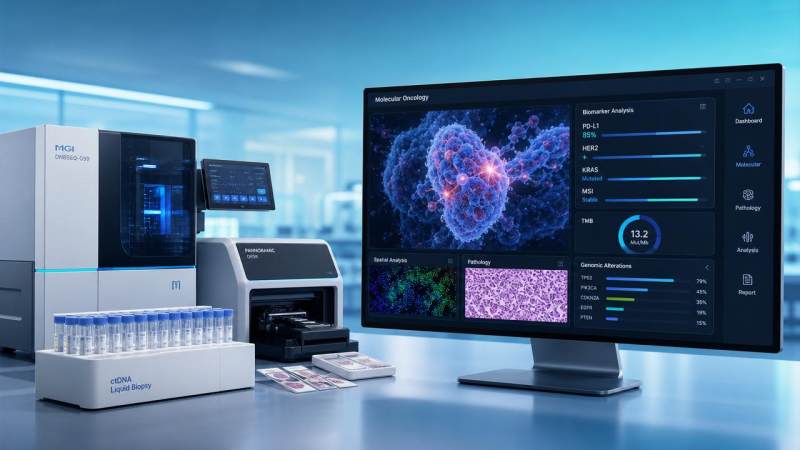
Cancer care remains the clearest example. Tumor profiling, liquid biopsy, companion diagnostics, and treatment monitoring have made precision medicine research directly relevant to everyday clinical pathways.
Rare disease programs are also advancing quickly. Genomic sequencing, phenotype mapping, and curated reference data help shorten diagnostic odysseys and improve therapy selection for small patient populations.
In infectious disease and immune disorders, precision medicine research supports patient stratification, response prediction, and more targeted laboratory interpretation. This is especially valuable when symptoms overlap across conditions.
Imaging is another fast-moving domain. AI-assisted radiology, quantitative biomarkers, and improved scanner subsystems are turning images into structured evidence that supports personalized decision-making.
The background signals behind this shift are becoming harder to ignore
Several market and clinical signals explain why precision medicine research is moving from specialist centers into broader care environments. The common thread is technical validation under real-world pressure.
First, molecular and imaging data volumes have expanded dramatically. Second, care teams expect faster answers. Third, regulators and quality systems require stronger proof of performance and traceability.
At the same time, healthcare systems face cost pressure. Technologies that reduce repeat testing, avoid ineffective treatment, or improve workflow efficiency gain attention more quickly than broad theoretical promises.
This is why precision medicine research often advances fastest in environments with mature laboratory operations, robust digital infrastructure, and clear pathways for technical benchmarking.
Why precision medicine research is advancing now
The main drivers are not only scientific. Progress depends on engineering quality, standards compliance, data governance, and repeatable validation across instruments, assays, software, and clinical settings.
Technical validation has become the central filter
Many tools can generate data. Far fewer can produce standardized, clinically interpretable, and audit-ready outputs across different institutions and operating conditions.
That distinction explains where precision medicine research moves fastest. Adoption is strongest where performance claims can be matched with verification, benchmarking, and post-deployment quality monitoring.
The impact reaches diagnostics, imaging, infrastructure, and research workflows
Precision medicine research affects more than test menus. It changes how devices are selected, how laboratories are designed, and how clinical evidence is translated into operational practice.
- Diagnostics platforms need higher analytical precision and stronger quality control.
- Imaging systems must support quantitative analysis, not only visual review.
- Hospital infrastructure must enable secure data flow between departments.
- Life science tools must generate reference-grade data for translational use.
- Home care and rehabilitation technologies may increasingly use biomarker-linked personalization.
This cross-sector effect is why independent technical repositories matter. Decision quality improves when imaging components, IVD systems, biomaterials, and software are reviewed against shared standards.
Global Medical & Life Sciences supports this need through transparent benchmarking across five critical pillars. That broader view helps connect laboratory capability with engineering integrity and clinical relevance.
Where care improvement becomes measurable first
Not every innovation creates equal value immediately. Precision medicine research shows the clearest early return where outcomes can be measured through speed, accuracy, targeting, or reduced treatment waste.
High-impact areas
- Oncology: biomarker-led therapy selection and monitoring.
- Rare disease: earlier diagnosis through integrated genomic workflows.
- Pathology: digital review and AI-supported pattern recognition.
- Immunology: stratified treatment and response assessment.
- Radiology: structured imaging biomarkers for treatment planning.
In each case, precision medicine research succeeds when data quality supports action. Fast care improvement rarely comes from novelty alone. It comes from trustworthy evidence embedded into routine workflows.
What deserves close attention over the next planning cycle
Organizations tracking precision medicine research should focus on a small set of signals. These markers often predict whether a technology will scale clinically, operationally, and regulatorily.
- Analytical reproducibility across sites, operators, and sample types.
- Compatibility with laboratory information systems and imaging archives.
- Alignment with ISO 13485, FDA expectations, and CE MDR evidence needs.
- Transparency of training data for AI-supported tools.
- Ability to generate outcomes-linked metrics, not just technical outputs.
- Supply chain resilience for critical components and consumables.
These factors are especially important in comprehensive healthcare environments. Cross-functional value depends on whether one upgrade strengthens adjacent systems instead of creating isolated data islands.
A practical way to judge future readiness
A useful assessment model combines technical maturity, evidence quality, integration readiness, and compliance alignment. Precision medicine research performs best when all four are reviewed together.
This approach reduces the risk of adopting impressive tools with weak operational durability. It also helps identify technologies that can support long-term care transformation across multiple service lines.
The next move should be evidence-led, not trend-led
Precision medicine research will continue expanding, but care improvement will remain uneven. The fastest gains will stay concentrated where data are standardized, validation is rigorous, and infrastructure supports continuous learning.
A practical next step is to compare current diagnostic, imaging, and laboratory assets against outcome-linked requirements. Gaps in interoperability, quality documentation, and analytical performance often appear before capacity limits do.
Using independent intelligence and technical benchmarking can make that review more reliable. In a market shaped by precision medicine research, the strongest decisions come from verified evidence, not broad claims.
As precision medicine research keeps reshaping healthcare, organizations that connect innovation with standards-based evaluation will be best positioned to capture measurable clinical and operational value.
Recommended News
Metadata & Tools
Related Research
- Immunoassay Cross-Reactivity Metrics: Calculating Percentages and Assessing BiasMaster immunoassay cross-reactivity metrics: learn to calculate percentages, assess assay bias, and evaluate clinical impact with practical examples for better-informed decisions.
- Choosing a Lab Tools Supplier: Quality Checks, Lead Times, and Warranty TermsChoose a lab tools supplier with confidence. Discover how to verify quality, confirm lead times, and compare warranty terms to avoid costly delays and protect your lab’s budget.
- Choosing Interactive Pet Toys: Matching Size, Play Style, and Safety NeedsExplore nteractivepettoys matched to your pet’s size, play style, and safety needs. Compare puzzles, treat dispensers, and moving toys to choose smarter and make playtime more rewarding.
- NGS Sequencing Cost Benchmark Report: Comparing Total Costs per SampleNGS sequencing cost benchmark report: compare total costs per accepted sample, uncover hidden expenses, and evaluate suppliers with confidence to make smarter procurement decisions.
- Diagnostic Imaging Market Outlook: Growth Opportunities in CT, MRI, and UltrasoundExplore the diagnostic imaging market outlook for CT, MRI, and ultrasound. Discover growth opportunities, technology trends, and procurement insights to guide smarter healthcare investments.