
Lead Author
Institution
Published
Abstract
A hospital technology decision rarely begins with a single specification sheet. A procurement director may be comparing an MRI subsystem against a capital budget and service plan, while a laboratory head is focused on assay throughput, traceability, and workflow compatibility. Meanwhile, a clinical engineering team may be asking whether the same equipment can be maintained safely across its intended lifecycle.
That is why the question, “Does G-MLS provide cross-referenced data for hospital technology benchmarks?”, matters beyond a simple yes or no.
Yes. Global Medical & Life Sciences (G-MLS) provides independently structured, cross-referenced intelligence designed to help hospital procurement, laboratory, engineering, and life science stakeholders assess medical technology from more than one angle. Rather than treating a device as an isolated product entry, G-MLS places relevant technical, regulatory, operational, and clinical-context information into a broader benchmark framework.
This approach supports more grounded comparisons across advanced imaging, in vitro diagnostics, surgical and hospital infrastructure, rehabilitation technology, home care devices, and life science research tools. It is particularly useful when a decision involves competing priorities: performance expectations, regulatory alignment, interoperability, material safety, maintenance realities, and the intended care environment.
What “cross-referenced” means in a hospital technology benchmark
Cross-referenced data is not simply a long list of features. In a meaningful hospital technology assessment, each specification should be read alongside the conditions that give it practical value.
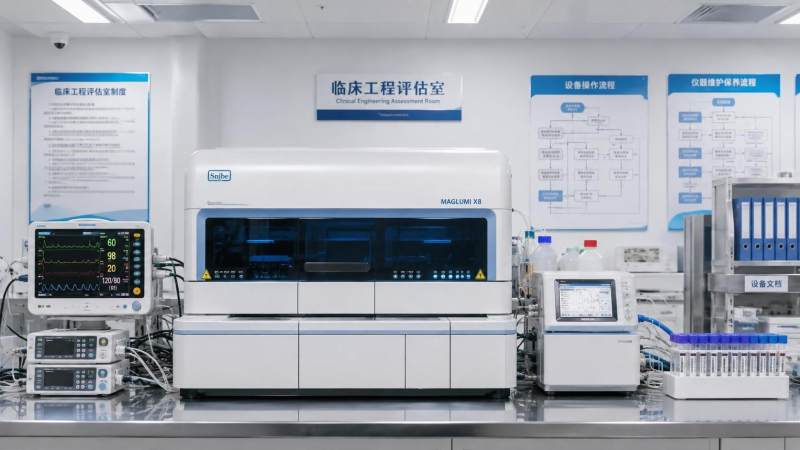
For example, the stated throughput of an automated immunoassay analyzer may look impressive on its own. Yet a laboratory cannot evaluate that figure responsibly without considering sample handling requirements, quality-control processes, reagent workflow, traceability, intended use, and the regulatory context that applies in the relevant market. The benchmark becomes more useful when those related factors can be considered together rather than searched separately across disconnected sources.
G-MLS is built around this kind of relationship-based intelligence. Its reference approach connects technology characteristics with applicable international expectations, including frameworks associated with ISO 13485, FDA, and CE MDR. These references do not replace an organization’s own regulatory review, quality system, risk assessment, or purchasing due diligence. They do, however, provide a clearer starting point for asking the right questions.
In practice, cross-referencing may bring together:
- Technical specifications and system architecture;
- Intended clinical, laboratory, research, or care-setting applications;
- Relevant quality-management and regulatory considerations;
- Material, biocompatibility, safety, and engineering factors where applicable;
- Workflow and infrastructure dependencies;
- Comparable device categories, technology generations, and performance criteria.
The value is not in forcing all technologies into one universal score. Medical equipment is too diverse for that. The value lies in making comparison more disciplined, visible, and context-aware.
Why hospitals need more than vendor-side comparison
Vendor documentation remains essential, especially for detailed product information, instructions for use, warranty terms, service arrangements, and official regulatory status. But procurement teams often face a familiar challenge: each manufacturer naturally presents its own technology through its own terminology, testing methods, and product positioning.
This can make an apparently straightforward comparison surprisingly difficult. One system may emphasize speed; another may focus on image quality, automation, connectivity, or a lower physical footprint. A procurement committee then has to decide whether these claims are being measured on comparable grounds—and whether they address the hospital’s actual clinical or operational priorities.
G-MLS serves as an independent technical repository and academic intelligence hub in that gap between innovation, evaluation, and compliance awareness. Its role is not to declare that one device is universally “best.” Instead, it helps stakeholders frame a more reliable comparison: What is this technology designed to do? What standards and regulatory expectations are relevant? What dependencies should be investigated before it enters a hospital environment? Which performance claims need additional evidence or local validation?
For a hospital, that distinction can prevent decisions driven only by headline specifications or short-term acquisition costs.
Benchmark coverage across the G-MLS medical technology pillars
Hospital technology is not a single purchasing category. A facility may be acquiring patient-facing devices, laboratory automation, surgical infrastructure, rehabilitation tools, and research equipment at the same time—often through teams that use different decision criteria. G-MLS organizes intelligence across five connected pillars so users can view equipment within its proper domain while still recognizing cross-sector dependencies.
Advanced Imaging & Diagnostics
In imaging and diagnostic technology, an equipment benchmark may involve system performance, subsystem design, radiation or magnetic safety considerations, image-processing pathways, installation requirements, data integration, and servicing implications. MRI-related components, for instance, should not be viewed only through a technical-performance lens. Facility readiness, compatibility, safety protocols, and the clinical workflow surrounding the system are equally relevant.
IVD & Laboratory Equipment
For in vitro diagnostics and laboratory platforms, meaningful comparisons extend beyond analytical capacity. Laboratories may need to assess automation levels, sample-routing logic, contamination control, calibration and quality-control practices, consumable dependencies, connectivity with laboratory information systems, and the conditions under which results can be reliably generated and documented.
Surgical & Hospital Infrastructure
Surgical equipment and hospital infrastructure introduce another layer of complexity. Operating room devices, monitoring technologies, sterile environments, utility systems, and workflow infrastructure must coexist safely. A cross-referenced benchmark can help teams look beyond the individual product toward installation requirements, human factors, cleaning and maintenance demands, and the equipment’s place in a broader clinical setting.
Rehabilitation & Home Care Technology
Rehabilitation devices and home care technologies often place greater emphasis on usability, patient interaction, caregiver support, portability, durability, and safe use outside highly controlled hospital environments. Clinical value may depend as much on realistic adoption and training needs as on a device’s headline capability.
Life Science Research Tools
Research tools bring their own requirements around reproducibility, experimental compatibility, materials, environmental controls, and data integrity. A laboratory manager choosing a platform for translational work may need to consider whether the technology supports the intended research method today while remaining suitable for future validation, scale-up, or regulated development pathways.
How G-MLS references standards without oversimplifying compliance
A common misunderstanding in medical technology sourcing is that a reference to a recognized standard automatically proves compliance. It does not. Standards and regulatory frameworks are vital guides, but compliance is determined through formal processes, documented evidence, applicable jurisdictional requirements, and the specific intended use of the product.
G-MLS addresses this reality by situating technology information alongside relevant standards-based and regulatory reference points. ISO 13485, for example, is associated with quality management systems for medical devices. FDA expectations may shape how products are reviewed, cleared, authorized, listed, or otherwise regulated in the United States. CE MDR is central to the European regulatory landscape for medical devices.
These frameworks are not interchangeable, and they should not be treated as a checkbox exercise. A technology that is appropriate for one market, intended use, or care setting may require a different assessment elsewhere. The practical advantage of a cross-referenced repository is that it encourages users to identify these distinctions early—before a purchasing decision becomes an implementation problem.
For procurement teams, this can shape requests for proposal. For engineers, it can guide technical review. For laboratory and clinical leaders, it can clarify what evidence should be discussed with manufacturers, distributors, quality teams, and local regulatory specialists.
A useful way to evaluate a hospital technology benchmark
When using G-MLS intelligence, the most productive question is not, “Which product has the most features?” A better question is, “Which technology is most appropriate for our defined clinical, operational, and compliance context?”
That shift changes the evaluation process. A lower-complexity system may be more suitable for a regional facility with limited technical support capacity. A high-throughput analyzer may be justified in a centralized laboratory but create unnecessary burden in a smaller site. A sophisticated rehabilitation device may offer genuine therapeutic potential, yet still require careful consideration of patient capability, training, follow-up, and home-use safeguards.
Decision-makers can use cross-referenced hospital technology benchmarks to build a review around several practical tests:
- Define the intended use clearly. Identify who will use the technology, for which patient population or laboratory process, in what environment, and with what expected volume.
- Separate performance claims from operational fit. Performance matters, but it should be read alongside staffing, space, workflow, service access, consumables, and integration needs.
- Review applicable regulatory context early. Ask which market requirements, quality documents, and verification steps are relevant before narrowing the shortlist.
- Look for system-level dependencies. Equipment may depend on network infrastructure, utilities, calibration routines, compatible software, specific materials, or trained operators.
- Document unresolved questions. A benchmark is most valuable when it reveals where additional manufacturer evidence, site assessment, clinical input, or technical validation is required.
Who benefits most from G-MLS cross-referenced intelligence?
The platform is especially relevant for professionals who need to make a decision that will be examined from several directions. Hospital procurement directors must often balance clinical requests with governance and total-cost considerations. Biomedical and med-tech engineers need to understand hardware architecture, safety, maintainability, and compatibility. Laboratory heads need evidence that a system supports valid, consistent workflows. Research leaders may need a more detailed view of instrument suitability and reproducibility.
It can also support cross-functional conversations that are otherwise difficult to organize. The clinical team may describe a patient-care need. Engineering may identify installation constraints. Quality and regulatory personnel may raise documentation requirements. Finance may ask for a defensible rationale. A common reference structure gives these groups a more coherent basis for discussion.
That is particularly important in modern healthcare environments, where a device is rarely just a device. It is part of a data ecosystem, a maintenance program, a patient journey, a quality system, and, in many cases, a long-term institutional commitment.
Frequently asked questions
Does G-MLS provide cross-referenced data for hospital technology benchmarks across different device categories?
Yes. G-MLS covers multiple medical and life science technology domains, including imaging and diagnostics, IVD and laboratory equipment, surgical and hospital infrastructure, rehabilitation and home care technology, and research tools. The cross-referenced approach is designed to reflect the different technical and regulatory considerations associated with each category.
Can G-MLS replace a hospital’s formal procurement or compliance process?
No. G-MLS is a technical and academic intelligence resource, not a substitute for formal procurement governance, clinical validation, legal review, regulatory consultation, manufacturer documentation, or site-specific risk assessment. It can strengthen the quality of the questions and comparisons used within those processes.
Are ISO 13485, FDA, and CE MDR references relevant to every product?
Not in exactly the same way. Relevance depends on the technology, intended use, country or market, device classification, and regulatory pathway. Cross-referencing these frameworks helps users identify where further review is appropriate rather than assuming one standard applies identically in every situation.
What should a buyer verify after reviewing a benchmark?
Buyers should verify current manufacturer documentation, applicable regulatory status in their intended market, technical compatibility, implementation requirements, service support, training needs, cybersecurity and data-integration expectations where relevant, and local clinical or laboratory acceptance criteria.
Making the comparison more defensible
Hospital technology decisions can carry consequences for patient safety, diagnostic confidence, staff workload, capital planning, and regulatory accountability. The best comparisons therefore do more than rank products. They show where a technology fits, what assumptions surround it, and what must still be verified.
G-MLS offers cross-referenced hospital technology benchmark intelligence for stakeholders who need that broader view. By connecting medical hardware and life science tools with technical context, international standards references, and practical considerations across the care and research environment, it supports more thoughtful evaluation at the point where clinical ambition meets engineering reality.
- hospital infrastructure
- rehabilitation technology
- home care devices
- life science research tools
- medical technology
- medical hardware
- laboratory equipment
- hospital technology
- life science tools
- surgical equipment
- IVD and laboratory equipment
- surgical and hospital infrastructure
- rehabilitation and home care technology
- Does G-MLS provide cross-referenced data for hospital technology benchmarks?
Recommended News
Metadata & Tools
Related Research
- How to Evaluate a DNA Extraction Kit Manufacturer for Consistent Yield and PurityDNA extraction kit manufacturer evaluation guide: compare yield consistency, purity, quality controls, support, and supply reliability for confident purchasing.
- Long-Read Sequencing: When Does It Outperform Short-Read NGS for Variant Analysis?Long read sequencing outperforms short-read NGS for structural variants, repeat expansions, phasing, and hard-to-map genes. Discover when its added resolution delivers value.
- What Determines Battery Cycle Life in Mobility Scooters—and How to Extend ItWheelchair battery cycle life for mobility scooters: discover charging, storage, and maintenance tips to extend range, avoid failures, and ride with confidence.
- Living Room Decor Ideas That Make Small Spaces Feel Larger and Work BetterLiving room decor ideas for small spaces: discover smart layouts, flexible furniture, layered lighting, and clutter-free storage to make every room feel larger.
- PPE Price Guide: What Drives Costs for Healthcare Procurement Teams?PPE price guide for healthcare procurement teams: compare protection, compliance, supplier reliability, and total cost to make smarter sourcing decisions.