
Lead Author
Institution
Published
Abstract
Biocompatible materials are central to clinical innovation, shaping safer implants, more reliable IVD equipment, and durable components in medical imaging equipment and hospital infrastructure. For medical procurement teams, operators, and researchers, understanding how these materials align with medical device standards is essential to evaluating performance, compliance, and long-term value across life science tools, automated immunoassay analyzers, and even home healthcare technology.
In practical medical use, no single biocompatible material is “best” in every situation. The best choice depends on where the material is used, how long it contacts the body, what chemicals or sterilization methods it must withstand, and what regulatory evidence supports it. For most decision-makers, the key question is not simply whether a material is biocompatible, but whether it is biocompatible enough for the intended use, manufacturable at consistent quality, and compliant with ISO, FDA, and CE MDR expectations.
Which biocompatible materials are most trusted in medical applications?
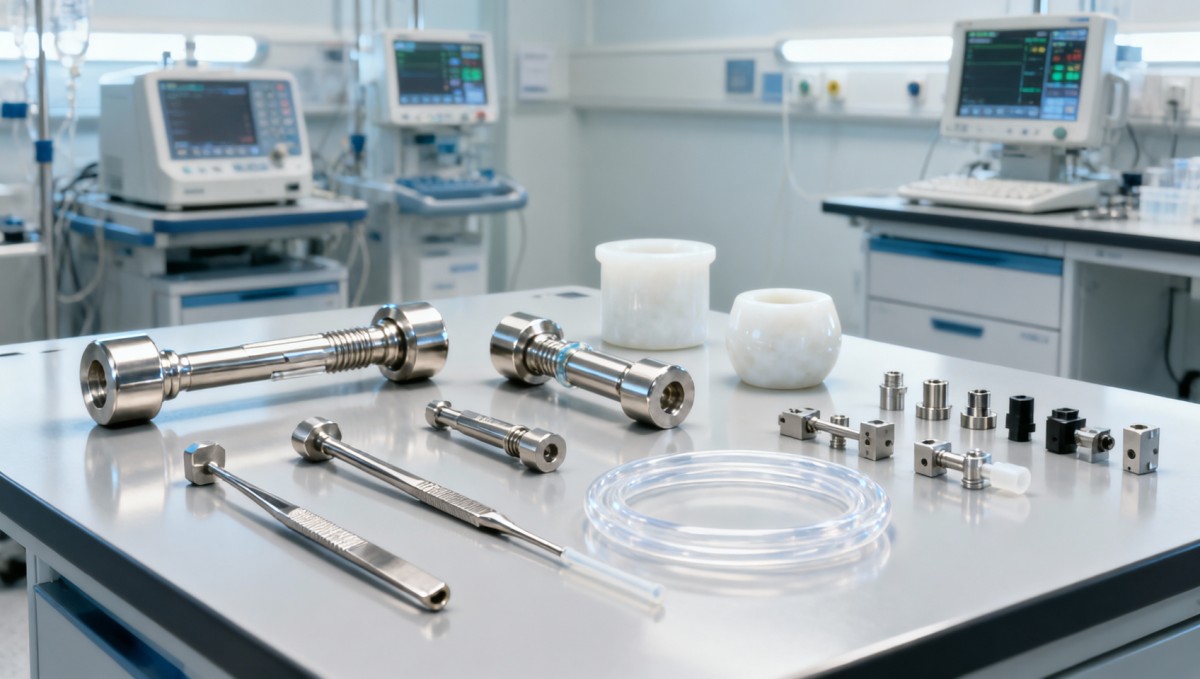
The materials most widely trusted in medical use generally fall into a few high-value categories: medical-grade stainless steel, titanium and titanium alloys, cobalt-chromium alloys, ceramics, silicone, polyethylene, PEEK, PTFE, and selected medical-grade elastomers and polymers. Each performs well in specific environments, but each also carries trade-offs.
Titanium and titanium alloys are often preferred for implants because they combine strong corrosion resistance, high strength-to-weight ratio, and excellent tissue compatibility. They are widely used in orthopedic implants, dental implants, and fixation devices.
Medical-grade stainless steel, especially 316L, remains important in surgical instruments, temporary implants, hospital equipment, and structural components. It is cost-effective and mechanically reliable, though it may be less suitable than titanium for long-term implantation in some scenarios.
Cobalt-chromium alloys are chosen when exceptional wear resistance and strength are needed, such as in joint replacements and certain cardiovascular devices. However, material selection must consider ion release risk, manufacturing precision, and long-term biological response.
Ceramics such as alumina and zirconia are valued for hardness, chemical stability, and low wear. They are common in dental applications, joint components, and specialized device surfaces. Their brittleness, however, can limit use in impact-prone designs.
Silicone is highly important in catheters, tubing, seals, respiratory interfaces, and soft-contact applications because of flexibility, chemical stability, and patient comfort. It is not ideal for every load-bearing need, but it is one of the most practical materials for prolonged soft-tissue contact.
PEEK has become increasingly relevant in advanced medical technology because it offers good mechanical performance, radiolucency, and sterilization resistance. It is used in spinal implants, instrument handles, and certain diagnostic equipment components.
PTFE and UHMWPE remain critical in applications requiring low friction, chemical resistance, and durability. UHMWPE is especially important in bearing surfaces for orthopedic devices, while PTFE is often used in vascular grafts, tubing, and seals.
For IVD equipment, automated immunoassay analyzers, and laboratory systems, the best materials are often not implant metals at all, but chemically resistant polymers, elastomers, and stainless steels that maintain sample integrity, survive repeated cleaning, and avoid extractables or leachables that could interfere with test results.
How should procurement teams and technical users decide which material works best?
The most useful way to evaluate biocompatible materials is to match the material to the actual medical risk profile. In other words, selection should start with use conditions, not with popularity.
1. Define the contact type and duration. A material used in a surgical implant faces very different expectations than one used in an analyzer fluid path or hospital bed surface. Implantable, externally communicating, and skin-contact devices each require different evidence thresholds.
2. Check the relevant biocompatibility pathway. Teams should look for testing and documentation aligned with ISO 10993, along with broader quality system evidence under ISO 13485. In regulated markets, material suitability must also support FDA submission or CE MDR technical documentation.
3. Review chemical resistance and sterilization compatibility. Some materials perform well in the body but degrade under steam sterilization, gamma radiation, EtO exposure, disinfectants, or aggressive lab reagents. In medical imaging equipment, lab instruments, and surgical infrastructure, this can affect safety and operating cost more than initial purchase price.
4. Consider mechanical and functional performance. Does the material need flexibility, rigidity, fatigue resistance, wear resistance, transparency, radiolucency, or electrical insulation? A material that is biologically acceptable but mechanically unstable is still a poor medical choice.
5. Evaluate extractables, leachables, and contamination risk. This is especially important in life science research tools, diagnostic consumables, tubing, seals, and fluid-contact parts. Material purity can directly influence test accuracy and reproducibility.
6. Assess long-term supply and manufacturing consistency. Procurement directors should confirm whether medical-grade formulations are available with traceable documentation, lot consistency, and stable global sourcing. A strong material on paper becomes risky if supply continuity is weak.
What materials work best for different medical use cases?
For long-term implants: titanium, titanium alloys, cobalt-chromium, specific ceramics, and UHMWPE are among the strongest candidates. The best option depends on load, wear profile, imaging compatibility, and expected service life.
For surgical instruments and hospital infrastructure: medical-grade stainless steel remains one of the best all-around choices due to corrosion resistance, cleanability, strength, and cost efficiency.
For tubing, seals, and patient-contact soft components: silicone, TPU, and selected medical elastomers often perform best, especially where flexibility, comfort, and repeated sterilization matter.
For lab equipment and IVD systems: PEEK, PTFE, polypropylene, polycarbonate, and stainless steel are often selected based on fluid compatibility, transparency needs, reagent resistance, and dimensional stability. In automated immunoassay analyzers, even minor material interactions can affect assay reliability.
For rehabilitation and home care technology: lightweight polymers, silicone interfaces, and durable coated metals are commonly preferred because they balance patient comfort, hygiene, portability, and cost.
For imaging and advanced diagnostics equipment: materials must often meet a more complex mix of requirements, including electromagnetic compatibility, cleanability, flame resistance, dimensional precision, and in some cases low artifact generation.
What are the most common mistakes when evaluating biocompatible materials?
One common mistake is treating “biocompatible” as a universal label. In reality, biocompatibility is application-specific. A material proven safe for short skin contact may not be suitable for blood contact or long-term implantation.
Another mistake is focusing only on the base material while ignoring additives, coatings, colorants, adhesives, and manufacturing residues. These factors can significantly change biological response and regulatory burden.
Teams also often underestimate the importance of processing. Surface finish, sterilization history, cleaning validation, and manufacturing controls can influence how a material behaves in real clinical use.
From a procurement perspective, the biggest avoidable error is choosing based only on unit cost. Lower-cost materials may increase maintenance frequency, reduce device lifespan, complicate validation, or create compliance risks that are far more expensive later.
What is the best overall answer for medical buyers, operators, and researchers?
The best biocompatible material in medical use is the one that matches the device’s clinical contact profile, regulatory pathway, mechanical demands, and lifecycle conditions with the lowest total risk. For implants, titanium and advanced ceramics are often top-tier choices. For surgical tools and infrastructure, stainless steel remains highly effective. For flexible patient-contact components, silicone is a leading option. For diagnostic systems and life science tools, chemically stable engineering polymers and high-grade metals are often the smartest choice.
For readers making real-world decisions, the most reliable approach is to compare materials through four lenses: intended use, biocompatibility evidence, operational durability, and compliance readiness. That framework provides a much stronger basis for selection than broad marketing claims or material popularity alone.
In modern medical technology, material choice is never just a technical detail. It directly affects patient safety, equipment reliability, validation complexity, and long-term procurement value. The strongest decisions come from linking verified material data with the realities of clinical use and international standards.
Recommended News
Metadata & Tools
Related Research
- Can LED lights for automotive industry reduce failures?LED lights for automotive industry can reduce failures by improving inspection accuracy, safety visibility, uptime, and maintenance planning. Learn key specs and selection tips.
- What limits rfid read range optimization results?rfid read range optimization depends on more than power. Discover key limits—tags, antennas, materials, noise, and validation—to improve reliable RFID performance.
- Are Educational robots worth the classroom cost?Educational robots can justify classroom costs when tied to measurable STEM outcomes, inclusive learning, teacher training, and lifecycle planning. See how to assess real value.
- Why do emerging markets radiology tenders fail?Emerging markets radiology tenders fail when specs, compliance, lifecycle costs, and service capacity misalign. Learn how to reduce risk and award smarter bids.
- How do sheet metal parts affect device durability?Sheet metal parts play a critical role in device durability, from corrosion resistance to vibration control. Learn what quality teams should verify before procurement.